
What is influencer marketing? It is a way to promote your brand by partnering with people who have a trusted, engaged online following. Instead of running an ad that people scroll past, you work with a creator who introduces your product to their audience in their own voice.
Many brands in Pakistan now use influencer marketing alongside paid ads and their own social media, especially in fashion, beauty, food, and lifestyle. Done well, it builds trust quickly. Done badly, it burns budget on reach that never turns into customers.
This guide explains what influencer marketing means, how it works, its benefits and risks, and how to judge whether it fits your brand.
Key takeaways
- Influencer marketing means partnering with online creators to promote your brand to their audience.
- It works because people trust creators they follow more than brand ads.
- Results depend on audience fit, a clear goal, and tracking set up before launch.
- It works best alongside your own social media, not instead of it.
What Is Influencer Marketing? A Guide for Pakistani Brands
Influencer marketing is a form of marketing in which a brand partners with an online creator to promote its product, service, or message to that creator’s audience. This strategy works because people tend to trust recommendations from someone they already follow more than a brand’s own advertising.
The meaning becomes clearer when you look at what influencer marketing is not:
- It is not the same as a celebrity endorsement. A celebrity ad is usually produced by the brand. Influencer content is made by the creator, in their own style, for their own followers.
- It is not just a paid ad. The content lives on the creator’s channel and reads like their normal posts, which is why audiences engage with it.
- It is rarely a single post. Brands often get better results from ongoing partnerships than from one-off mentions, because repeated recommendations build familiarity.
What Is an Influencer?
An influencer is a person who guides, inspires, and shapes the buying choices of a specific audience. Most social media influencers build that audience on Instagram, TikTok, YouTube, or Facebook by posting regularly about one area, such as food, fashion, skincare, tech, or parenting.
The Oxford Learner’s Dictionary definition of an influencer captures this well: a person who uses social media to recommend products or services and persuade potential buyers.
Follower count is only part of the picture. When you assess an influencer, three other factors are important:
- Relevance: Does their audience align with your customer profile?
- Engagement: Do followers comment, ask questions, and share, or do they simply scroll past?
- Trust: Do followers act on their recommendations, or do they view every post as nothing more than an advertisement?
For a local restaurant, a food content creator with a smaller but loyal audience—for instance, in Lahore—might be more valuable than a nationally recognized celebrity with millions of followers.
Influencers are often grouped by audience size, from nano and micro creators up to macro and celebrity influencers. Each type suits a different goal and budget; we cover them in a separate guide on types of influencers.
How Does Influencer Marketing Work?
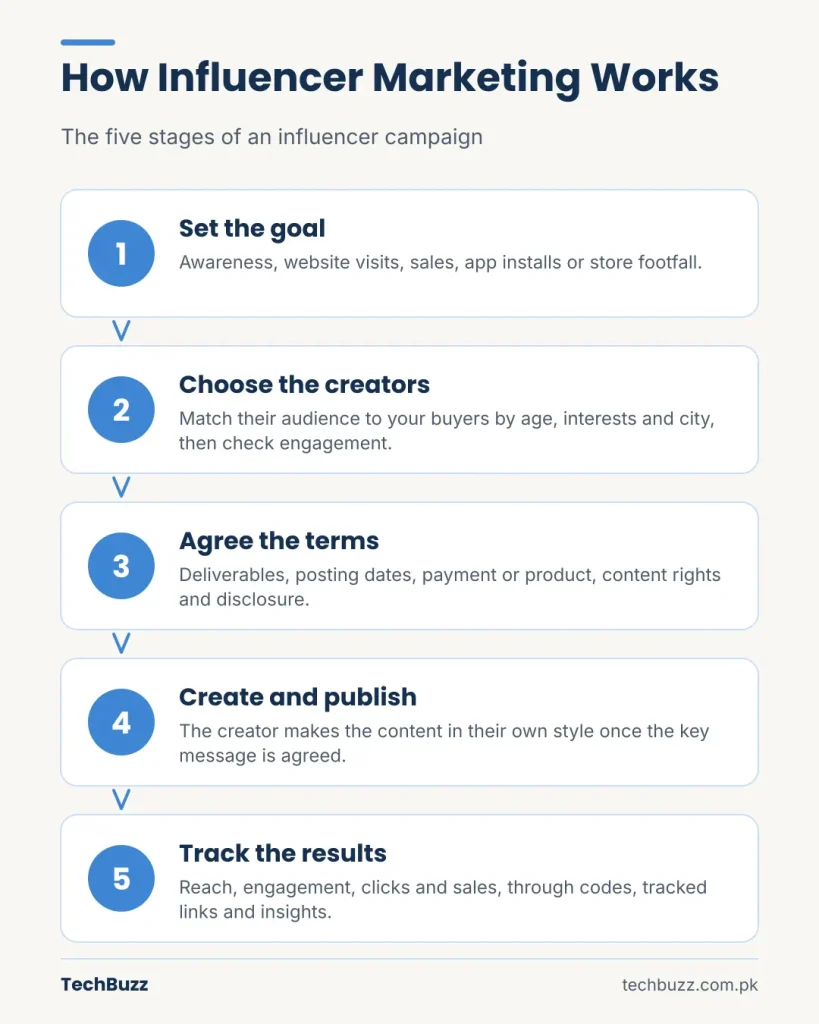
Influencer marketing works by turning a creator’s trust with their audience into attention for your brand. Most campaigns follow the same five stages:
- Set the goal. Decide what the campaign must achieve: awareness, website visits, sales, app installs, or footfall to a store.
- Choose the creators. Shortlist influencers whose audience matches your buyers by age, interests, and city, and check their engagement.
- Agree the terms. Confirm the deliverables, posting dates, payment or product exchange, who can reuse the content, and how the post will be disclosed.
- Create and publish. The creator makes the content in their own style, ideally after the brand approves the key message.
- Track the results. Measure reach, engagement, clicks, and sales using discount codes, tracked links, and platform insights.
In short: set a goal, choose creators whose audience matches your buyers, agree the terms in writing, let the creator make the content, and track every result.
Common types of influencer collaborations
| Format | What it is | Best for |
| Sponsored post or reel | The creator features your product in a paid post | Awareness and launches |
| Product review or unboxing | The creator tries the product and shares an honest opinion | Building trust before purchase |
| Discount code or affiliate link | Followers get a code; the creator may earn per sale | Direct, trackable sales |
| Giveaway | Followers enter to win your product | Quick reach and new followers |
| Brand ambassador | A long-term partnership with one creator | Ongoing trust and familiarity |
| Event or store visit | The creator covers a launch, opening or event | Footfall and local buzz |
Disclosure matters
Paid content should always be clearly labelled. Instagram says creators must add its Paid Partnership label when they receive payment in any form, including gifted products, as explained in Instagram’s branded content guidance. YouTube asks creators to switch on its paid promotion setting, which shows a disclosure label at the start of the video (YouTube Help: paid promotion disclosure).
If you also market to the US, the Federal Trade Commission’s disclosure guidance for social media influencers warns that relying on a platform’s built-in tool alone may not be enough. For other markets, such as the UK, check the local advertising rules before the campaign goes live.
Influencer Marketing Benefits for Brands
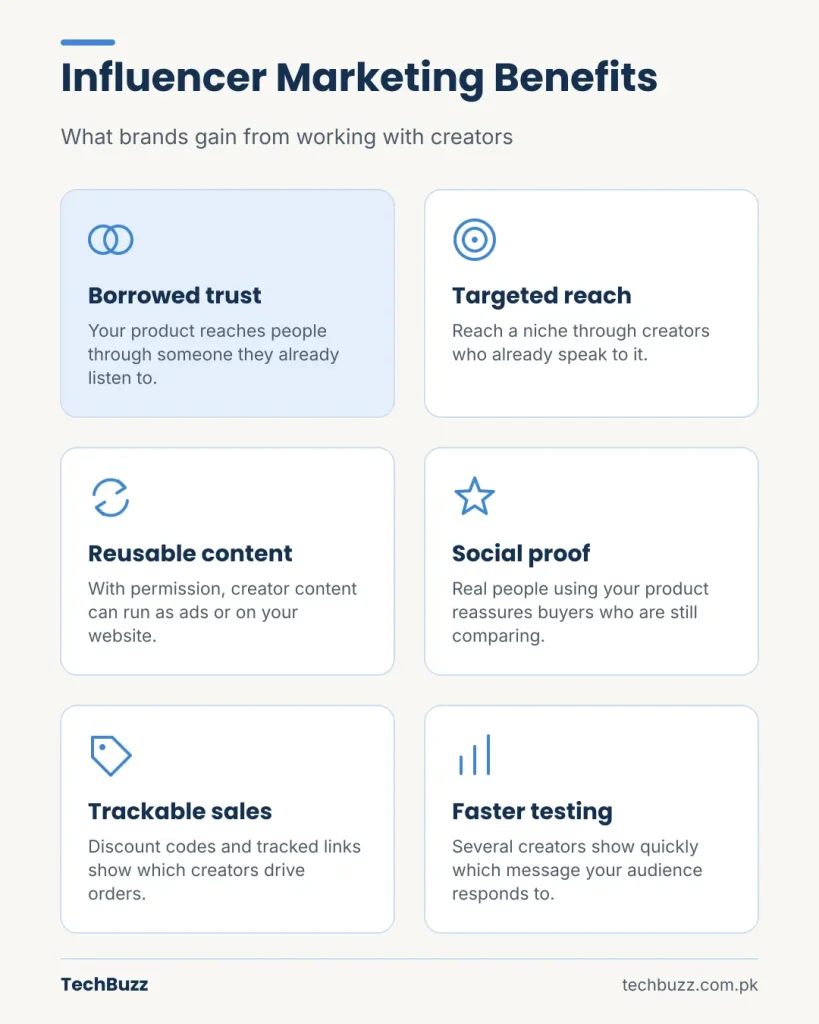
The main benefit of influencer marketing is borrowed trust: your product reaches people through someone they already listen to. Other benefits include:
- Reach a specific audience. You can target a niche, such as working mothers in Karachi or gamers in Lahore, through creators who already speak to them.
- Content you can reuse. With the creator’s permission, their videos and photos can run as ads or appear on your website and product pages.
- Social proof. Real people using your product reassure new buyers who are still comparing options.
- Trackable sales. Discount codes and tracked links show which creators actually drive orders.
- Faster testing. Working with several creators shows you quickly which message, product, or format your audience responds to.
Why Is Influencer Marketing Important?
Influencer marketing is important because the way people discover and choose products has changed. Many shoppers now look up to well-known influencers on social media for their recommendations before they buy, and they look for opinions from real users rather than the brand itself.
At the same time, people now ignore traditional ads. A creator’s recommendation feels like advice, not advertising, which is why it often gets attention when ads do not.
Is Influencer Marketing Effective?
Influencer marketing can be very effective, but results depend on how the campaign is carried out. Paying for a post is easy; turning that post into customers is the hard part.
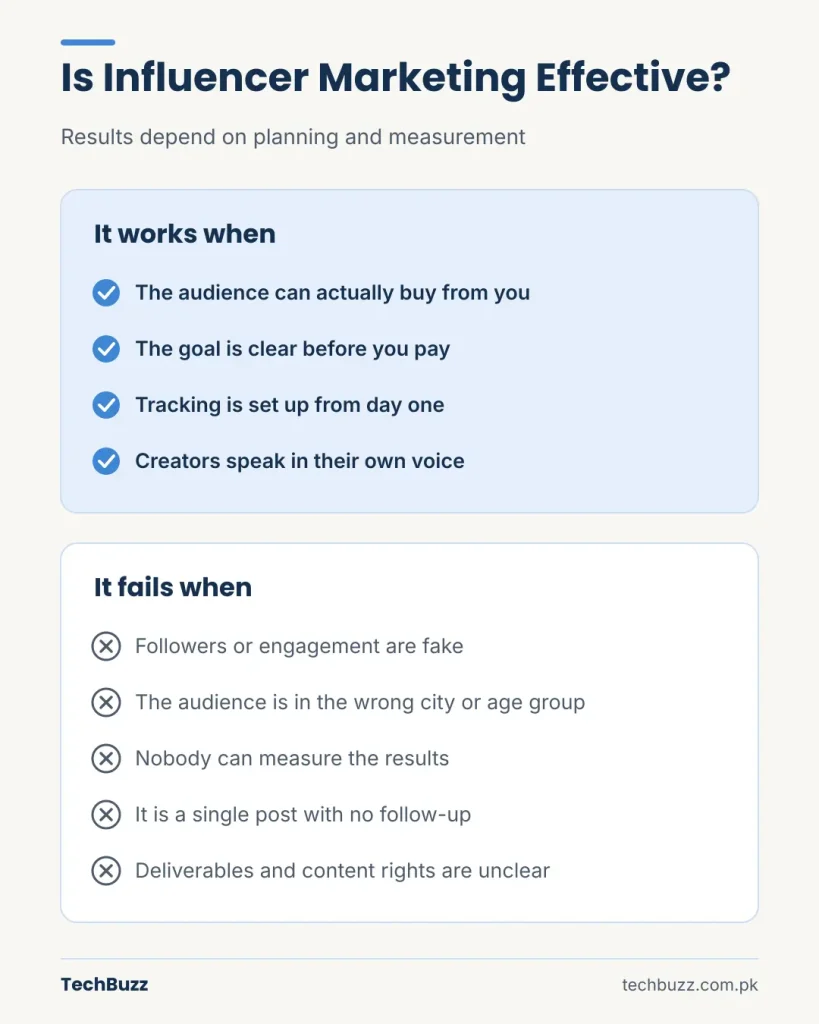
What usually decides whether a campaign works:
- Audience fit: the creator’s followers are people who could actually buy from you.
- A clear goal: you know whether you are paying for awareness, followers, or sales.
- Tracking from day one: codes, links, and insights are set up before anything is posted.
- Creative freedom: creators who speak in their own voice outperform those reading a brand script.
Common reasons campaigns fail:
- Creators with bought followers or fake engagement
- An audience in the wrong city, country, or age group
- No way to measure results, so nobody knows what worked
- Posts without follow-ups
- Unclear agreements about deliverables, dates, and content rights
Influencer Marketing vs Social Media Marketing
The difference is whose audience you use: social media marketing builds your own channels, while influencer marketing borrows someone else’s.
| Influencer marketing | Social media marketing | |
| Audience | The creator’s followers | Your brand’s own followers |
| Who makes the content | The creator | Your brand or agency |
| Control over the message | Shared with the creator | Full |
| Trust | High, because it comes from a person | Built slowly over time |
| Speed of reach | Fast, from the first post | Gradual |
| What you keep | Reusable content, if agreed | A growing audience you own |
The two work best together. Influencers bring new people to your brand; your own social media gives them a reason to follow, return, and buy. If your channels are inactive when that new traffic arrives, much of the campaign’s value is lost. Strong social media marketing services make sure your profiles are ready before any creator sends their audience your way.
Where Influencer Marketing Fits in Digital Marketing
Influencer marketing in digital marketing is one channel among several, and it works best when it is connected to the others:
- Content: creator videos and photos can feed your own posts, website, and product pages.
- Paid ads: the best-performing creator content can be boosted as ads, often through partnership ads on Instagram and Facebook.
- SEO: campaigns can increase the number of people searching for your brand name, so your website needs to be ready to rank for it.
- Email and landing pages: a dedicated page or offer for each campaign makes results easier to track.
Treating influencer marketing as part of a joined-up digital marketing plan, rather than a separate experiment, is what turns attention into measurable results.
Influencer Marketing in Pakistan
Influencer marketing in Pakistan follows the same principles as anywhere else, but a few local factors shape what works:
- Platforms: Instagram, TikTok, YouTube, and Facebook are where most Pakistani creators build their audiences, and the right choice depends on who you sell to.
- Language: content in Urdu or Roman Urdu often feels more natural to local audiences than English-only posts.
- City-level reach: creators with a strong following in one city, such as Lahore, Karachi, or Islamabad, suit restaurants, salons, clinics, and retail stores that serve that city.
- Seasons: demand peaks around Ramadan, Eid, wedding season, and big online sale events, so creators are booked early for these periods.
- Sectors: fashion and clothing, beauty and skincare, food and restaurants, and tech are among the categories where creators are most active.
In short: in Pakistan, pick the platform your buyers use, let creators speak in Urdu or Roman Urdu, use city-level creators for local businesses, and book early for Ramadan, Eid, and sale seasons.
If you work in one of these sectors, our guides on digital marketing for skincare brands and how to market a clothing brand show how influencers fit into a wider plan.
Ready to Plan Your First Campaign?
Knowing what influencer marketing is gets you halfway; the results come from the plan behind it. Our next guide walks through how to build an influencer marketing strategy, from setting goals to choosing creators and measuring results.
If you would rather have a team handle it, TechBuzz plans and runs social media campaigns for brands in Pakistan and abroad, built around clear goals rather than vanity metrics. Talk to our team about where influencer marketing fits for your brand.
Frequently Asked Questions
Who is an influencer?
An influencer is someone whose content and opinions affect what their followers think and buy. They can be a full-time creator, an expert in their field or a local personality, as long as their audience trusts them.
Is influencer marketing only for big brands?
No. Small and local businesses often do well with smaller creators, whose audiences are focused and highly engaged. A restaurant or boutique can start with a few local creators and a modest budget.
What is the difference between an influencer and a content creator?
A content creator makes content; an influencer is a creator whose audience acts on their recommendations. Many creators are both, but not every creator has the trust that makes them effective for brand partnerships.
How do you measure influencer marketing results?
Match the measure to the goal. Track reach and engagement for awareness, link clicks for traffic, and discount-code or tracked-link sales for revenue. Set the tracking up before any content goes live.
How much does influencer marketing cost in Pakistan?
There is no fixed rate. Cost depends on the creator's audience size and niche, the platform, the number and type of posts, and whether you want rights to reuse the content. Some smaller creators work in exchange for products, while established creators charge per post or per campaign.