
Summary: This guide explains how to build an effective influencer marketing strategy, from setting clear goals and identifying your target audience to choosing the right influencers, setting budgets, and tracking campaign results. It also covers practical tips, a simple campaign plan template, and ways Pakistani brands can improve their influencer partnerships.
A Complete Guide to Influencer Marketing Strategy: How to Build One Step by Step
The majority of unsuccessful influencer campaigns happen because there simply isn’t a strategy in place. Brands will select a few popular names, send them free products, and then won’t be able to tell if anything has been successful. With an influencer marketing strategy in place, this problem can be avoided.
This guide will show you exactly how to create your own influencer marketing strategy. This includes setting your goals, selecting the right influencers in Pakistan, creating a brief, and tracking the performance of each partnership. If you are new to the subject, we recommend reading our guide on what influencer marketing is. Then return here to plan.
Key points
- Start with one core goal and ensure you have a metric to prove it.
- Select influencers that match your audience and will really engage.
- With a brief and simple contract, most issues will be avoided.
- Ensure each influencer has their own tracking link/discount code.
- Use a test campaign, and then invest a higher budget into those that perform.
What Is an Influencer Marketing Strategy?
Your brand’s influencer marketing strategy outlines your goals, audience, influencers you will work with, creatives you would like them to create, and how to measure success. It’s the overarching document that makes sure all of your campaigns are on point.
There are three easily confused terms to be aware of:
| Term | What it covers | Example |
| Influencer marketing strategy | The overall approach: goals, audience, creator types, budget rules, how success is measured | “Use local food creators to grow weekday footfall at our Lahore branches this year.” |
| Influencer marketing plan | The working document for a set period: timelines, creators, deliverables, budget split | “Q1: six creators, two posts each, launch in week two.” |
| Influencer marketing campaign | One push with a start and end date | “Iftar menu campaign for the first three weeks of Ramadan.” |
A strategy without campaigns is just a piece of paper. A campaign without a strategy can become an experiment that’s hard to compare with others. You need both, in that order!
How to Create an Influencer Marketing Strategy in 8 Steps
An influencer marketing strategy can be developed using these 8 steps. Each step will lead to the next by limiting the options available. For example, knowing your objective will help determine your audience. Knowing your audience will help determine the platform and creators you should work with.
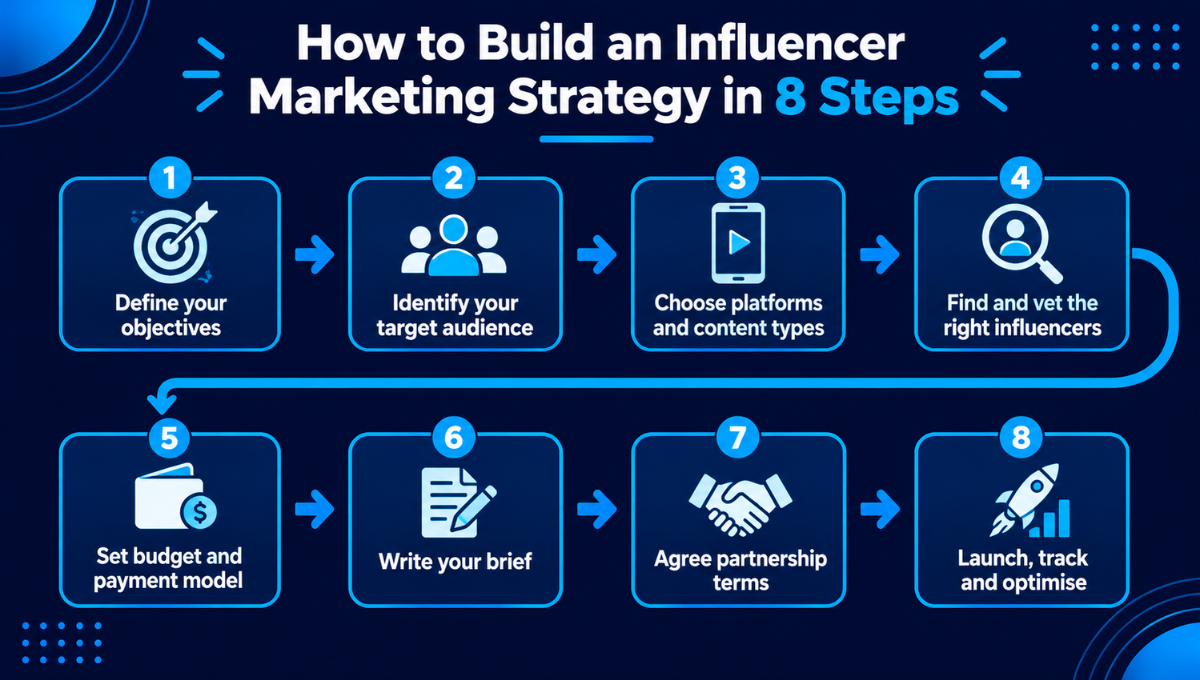
- Define your objectives
- Identify who your target audience is
- Identify your platform and content types
- Identify and vet the correct influencers
- Identify your budget and payment method
- Create your brief
- Agree partnership terms
- Launch, monitor and optimise
The sections below take each step in turn.
Step 1: Set Clear Influencer Marketing Goals
Everything revolves around your influencer marketing goals. Look at influencer marketing strategy examples to identify a clear objective for each campaign.
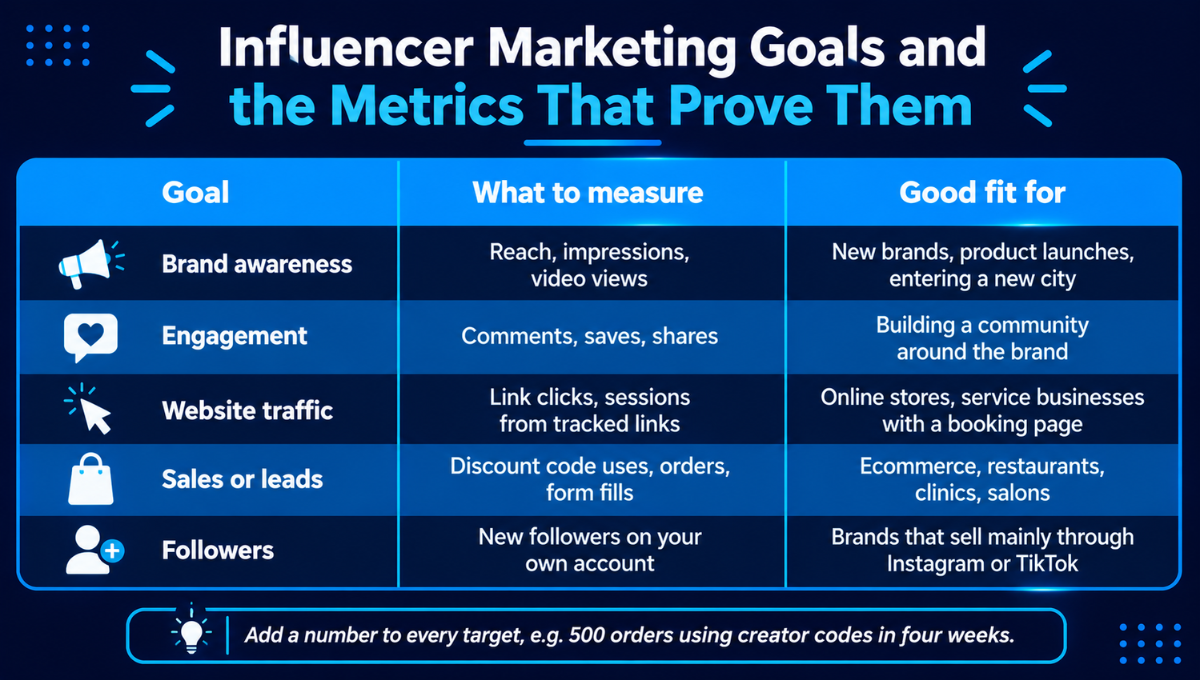
Instead of targeting more sales, followers, and awareness all at once, focus on one main outcome and choose a metric to measure its success.
| Goal | What to measure | Good fit for |
| Brand awareness | Reach, impressions, video views | New brands, product launches, entering a new city |
| Engagement | Comments, saves, shares | Building a community around the brand |
| Website traffic | Link clicks, sessions from tracked links | Online stores, service businesses with a booking page |
| Sales or leads | Discount code uses, orders, form fills | Ecommerce, restaurants, clinics, salons |
| Followers | New followers on your own account | Brands that sell mainly through Instagram or TikTok |
Add numbers to the target. For example, “500 orders using creator codes in four weeks” or simply “Grow the brand”.
Step 2: Define the Audience You Want to Reach
Define your demographic. How old are the people you would like to target? What gender are they? Which city do they live in? What language are they most comfortable with? And finally, what are they interested in? Even if two brands (a bridal wear brand in Lahore and a gaming accessories store in Karachi) want to target the same demographic (20- 30-year-olds), they will need completely different creators.
Look at your existing customers. You’ll have access to Instagram and Facebook insights, website and order data to help you know exactly where they’re located and how old customers are. This is far more accurate than making a best guess.
Step 3: Choose Your Platforms and Content Formats
Use platforms that your audience is already on and choose the relevant format:
- Instagram – Reels, Stories (with link stickers), and carousels. Check out our Instagram trends roundup for more information.
- TikTok – Short, engaging videos. This can help you reach people who are not currently following you.
- YouTube – Long-form reviews, tutorials, and comparisons. This is great for technology, cars, education, and other products.
- Facebook – Can still be used to reach an older audience and community groups.
Don’t go for too many platforms. It’s better to have 1-2 platforms and really make the most out of them.
Step 4: Find the Right Influencers in Pakistan
The best creators for your brand might not be the biggest. To find the right influencers in Pakistan:
- Search hashtags and location tags. Search for your niche in your city. For example, if you’re in the food niche, search #food + #Lahore, #food + #Karachi, and/or #food + #Islamabad.
- Find out who is already talking about you. Find creators who have already mentioned or tagged your brand, or written reviews about your products for free.
- Search the tags used by your competitors. This will show you who the creators are within your category and what sort of content they have.
- Ask your customers who they follow.
- If you need a bigger list of creators quickly or don’t have time, then use an agency or influencer platform.
How to vet an influencer before you sign
Shortlisted creators should be evaluated on these factors to ensure you’re investing your budget wisely.
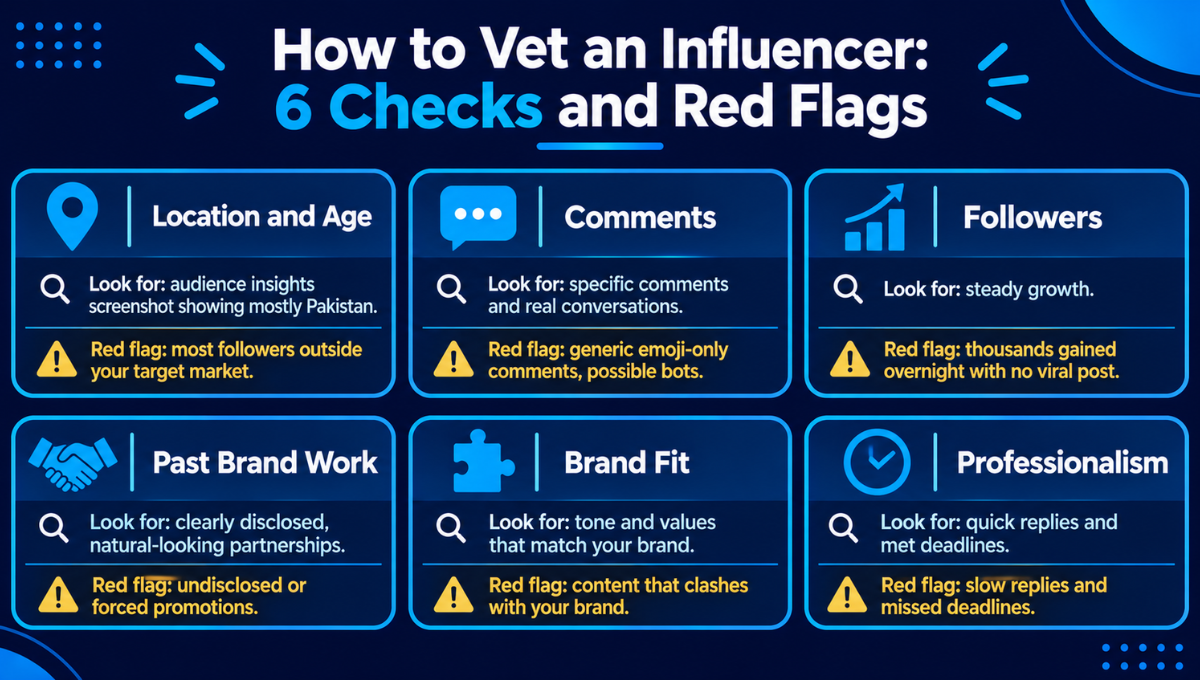
- Geographic and Age – Request a screenshot of their audience insights so you can see where the majority of their followers are from. If the majority aren’t located in Pakistan and you will only be targeting local audiences, this won’t be a good fit for you.
- Comments – Comments can give you insight into how engaged the audience is. If the comments are specific and the creator is having real conversations, then this is a good sign. If there are many generic comments using emojis, then this could be a sign of engagement groups or bots.
- Followers – This should be steady. A large increase in followers (thousands) overnight could be a red flag if there was no viral content.
- Previous Work With Brands – Have they worked with brands before? This will show you whether they were transparent with their partnerships and whether their content felt organic.
- Brand Fit – The creator should have a tone, values, and content that fit well with your brand.
- Professional – If they aren’t quick to reply and are missing deadlines in the initial conversation, this will often not improve throughout the campaign.
Set one specific objective, know your audience, and use real data from your customers. Choose 1 or 2 platforms, find creators who match your audience, check them out, and only pay once you’re happy.
Step 5: Set Your Budget and Payment Model
Decide how much you want to spend and what payment method you will use. Most creators will charge you for using their content in one of the following ways:
- Product gifting – The creator gets your product in return for creating content about it. This is good for smaller creators and new products but still needs to be advertised as it is a paid partnership.
- Flat fee – A set fee for every post, Reel, Story set, or package they create.
- Commission – They earn a percentage of every sale made through their code/link.
- Fee & Commission – A low flat rate fee with a bonus on sales. Both parties are focused on sales.
- Retainer – Monthly fee for an ongoing ambassador relationship.
Fees can vary dramatically depending on the size of the audience, niche, and platform. Get several quotes from creators and then decide how much you would like to spend. You may also want to set aside some money to boost your top-performing posts as paid ads once the campaign has started.
Step 6: Write the Influencer Campaign Brief
An influencer campaign brief ensures everyone involved in influencer marketing jobs is on the same page. Without one, creators may miss key product benefits, discount codes, or make unsupported claims. A well-written brief should be 1–2 pages long and include:
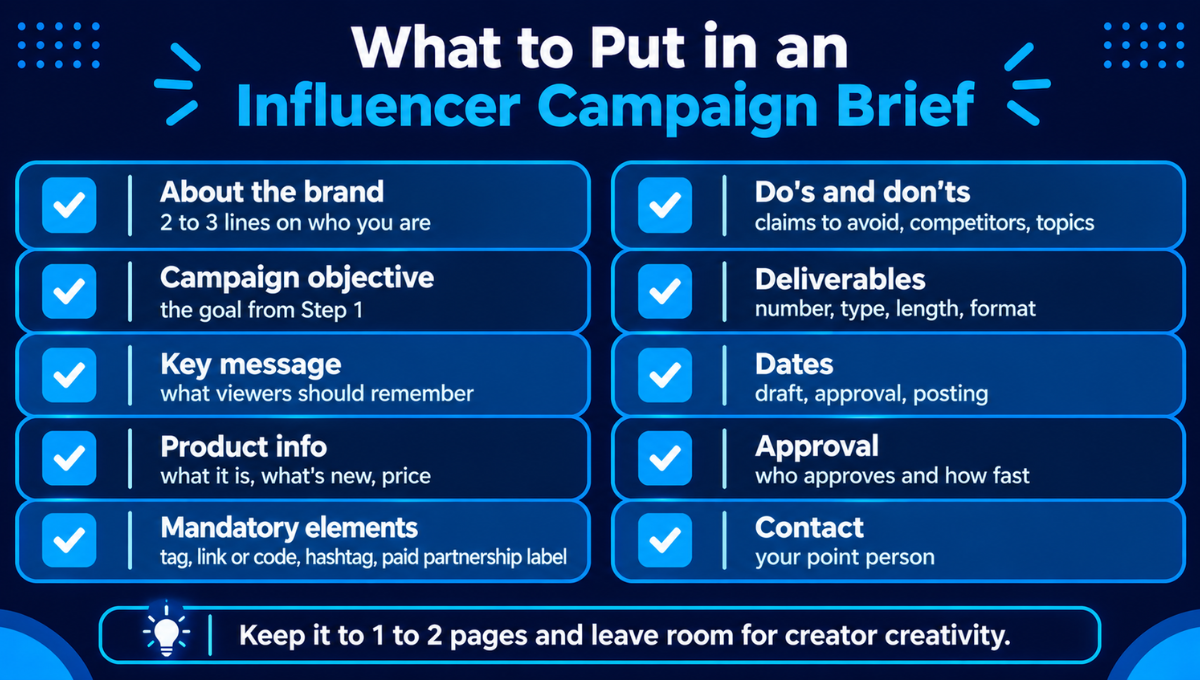
About the brand – 2-3 lines about who you are and who you provide for.
- Campaign objective – What you want to achieve from this campaign (this should be from step 1).
- Key message – What you want your audience to take away from the video.
- Product info – What it is, what’s new, and price (if you’re sharing).
- Mandatory – Your tag, link or code, hashtag, and paid partnership.
- What they can and can’t say – What they can’t claim, competitors they shouldn’t mention & topics to avoid. This is the most important part if you’re using skincare/health/finance products.
- Deliverables – How many, what type, length, and format.
- Dates – When to draft, when to approve, and when to post.
- Approval – Who will be approving drafts and how fast.
- Contact – Who to contact on your side.
Leave room for creativity. The audience will follow the creator for their voice, so normally a script won’t perform as well as a clear brief with some creative liberty.
Step 7: Agree on the Terms of the Influencer Partnership
Always put everything in writing, even if it’s just a gifting collab. This doesn’t need to be lengthy but should include:
- What they’ll deliver and when they’ll post it.
- How much you’ll be paying them, how and when (e.g., 50% in advance and 50% on delivery).
- Whether you can use their content, how much and for how long.
- Whether they can promote a competitor during this campaign.
- The number of revisions they can make.
How they’ll disclose this. On Instagram, creators are required to use the Paid Partnership label when receiving any payment (including free products). Refer to Instagram branded content guidelines for more info.
If they do well, convert this into an ongoing partnership. People trust ongoing authentic recommendations over a one-off sponsored post.
Step 8: Launch, Track and Improve
Tracking starts before the first post goes live. Give each creator their own way to measure results:
- Tracked links: add UTM parameters to each creator’s link so their visits show up separately in Google Analytics. Google explains how in its guide to building campaign URLs with UTM parameters.
- Unique discount codes: you’ll be able to see which creator brought in which sale. Even if customers are typing your URL or ordering via WhatsApp.
- Insights screenshot: ask creators to send you their post and story insights (how many people saw it, viewed it, and clicked on links). Stories only last for 24 hours, so make sure you’re both aware of this.
- Put all results in one sheet and compare cost per result across creators. Boost the strongest posts through partnership ads on Instagram and Facebook, rebook the creators who delivered, and replace the ones who didn’t. That review is what turns your first campaign into a working influencer marketing strategy.
Agree on the budget and payment structure. Send a summary to all content creators. Sign an easy agreement. Provide each content creator with their own link/code to know who gave what.
A Simple Influencer Marketing Plan Template
Once the strategy is set, turn each campaign into a one-page influencer marketing plan. Copy this table into a sheet and fill in one column per campaign:
| Section | What to fill in | Example |
| Campaign name | A short, clear name | Winter collection launch |
| Goal and target | One goal, a number, and a deadline | 400 orders through creator codes in 4 weeks |
| Audience | Age, city, language, interests | Women 22 to 35 in Lahore and Islamabad, Urdu and English |
| Platforms and formats | Where and what type of content | Instagram Reels and Stories |
| Creators | Number and type | 8 micro creators in fashion and lifestyle |
| Budget | Total, and how it’s split | Creator fees, product costs, ad boost |
| Key message | The one thing viewers should remember | Warm fabrics that still look festive |
| Tracking | Links, codes, and reports | One UTM link and one discount code per creator |
| Timeline | Key dates | Brief by week 1, drafts week 2, posts week 3 |
| Owner | Who runs it day to day | Social media lead |
The example values are only there to show the level of detail. Replace them with your own numbers.
Influencer Marketing Tips for Pakistani Brands
Here are some tips to consider when working with influencers to market to audiences in Pakistan:
- Plan and schedule campaigns around key times like Ramadan, Eid, wedding season, and big sales. Brief creators well in advance, ideally weeks out. If you’re selling clothes, our guide to how to market a clothing brand will give you further tips on planning around seasonal campaigns.
- Speak in the language of your audience. Using Urdu, Roman Urdu, or a blend of English often feels more authentic.
- Start small. Working with a few micro creators gives you an indication of what message and format work, without paying the high price of a celebrity post.
- Make sure codes are easy to use. If you’re taking orders via WhatsApp or DMs, prompt buyers to enter the code for the creator they bought from.
- Ensure you have reuse rights. Good quality content can be used on your product pages and ads for months, but only if you have it in your agreement.
- Use creators more than once. Usually, using creators for a 2nd and 3rd post will be more effective as they’re trusted by their audience.
Need Help Running Your Influencer Campaigns?
Having a clear strategy in place reduces much of the guesswork involved in working with influencers. However, using an influencer marketing hub and managing shortlists, briefs, drafts, and campaign results can still be time-consuming.
We create and run social media campaigns for brands both in Pakistan and internationally. If you’d like support with any of the steps above, take a look at our social media marketing services or talk to our team.
FAQs
What is the difference between an influencer marketing strategy and a campaign?
An influencer marketing strategy is the long-term plan, while a campaign is a short-term activity designed to achieve a specific goal, such as a product launch or Eid sale.
How long does an influencer marketing strategy take to show results?
Initial results, such as link clicks and code uses, may appear within days, but building brand awareness and trust takes longer. Evaluate results across multiple campaigns.
How many influencers should a small brand start with?
A small brand can start with a few micro-influencers, test different content formats, and increase the number once it identifies what works best.