
Summary: Digital marketing in healthcare plays an important role in helping people find doctors, compare hospitals, read patient reviews, and learn about different treatments. Therefore, healthcare businesses need a strong online presence to reach the right audience. At TechBuzz, we understand that every industry has different marketing needs. Our team combines SEO, paid advertising, website development, and social media to help businesses build a stronger online presence. Let’s explore how healthcare businesses can use digital channels to reach more people and grow their brands.
Benefits of Digital Marketing in Healthcare: A Complete Guide
Digital Marketing Strategy for Healthcare | Pharma Marketing | Contextual Targeting
The healthcare industry is progressive in many ways, but marketing strategies tend to lag behind other consumer-centric industries. Why? With closely monitored HIPAA regulations and the FDA constraining marketing efforts, it’s difficult for healthcare organizations to keep up with other industries’ marketing innovations.
Additionally, marketing strategy is not the priority in healthcare—patient care is (and rightfully so). Let’s discuss this in detail:
What Is Healthcare Marketing and Why Does It Matter?
 In the past, healthcare marketing has focused on traditional tactics such as print, TV, radio, and direct mail. Marketers would launch campaigns and hope for the best, unable to make real-time adjustments once the ads were published.
Hospitals also had an easier time acquiring patients because the population was, in general, less proactive about their health. Plus, healthcare costs were much lower than they are now, so patients did not reject or delay procedures based on cost, as happens presently.
Today’s healthcare consumer is much different than the healthcare consumer of the past. Patients are healthier, live longer, and rely on healthcare organizations less. Today’s patients are also able to do extensive research online, which means they are more particular about the services they receive. They also have access to physician reviews, ratings, and online forums to interact with other patients who may have similar conditions.
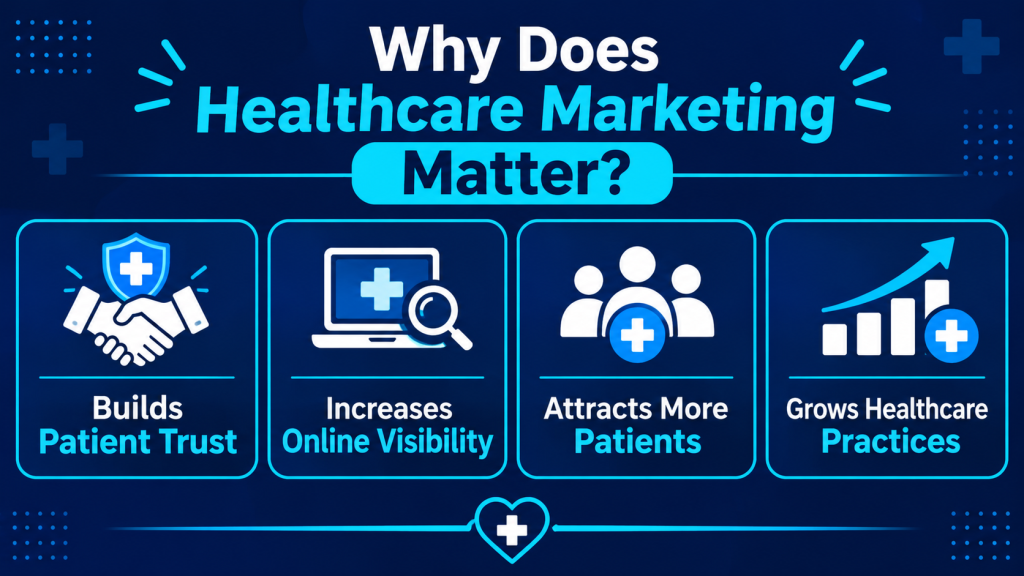
So, why is marketing important in healthcare? Here are some key reasons:
- Builds Trust: Helpful information makes people more confident in your services.
- Improves Visibility: People can find your clinic or hospital through Google.
- Attracts Patients: Targeted campaigns connect you with people looking for care.
- Educates People: Useful content helps readers understand health topics.
- Supports Growth: A strong online presence creates more opportunities for enquiries and appointments.
How Does Digital Marketing in Healthcare Help You Grow?
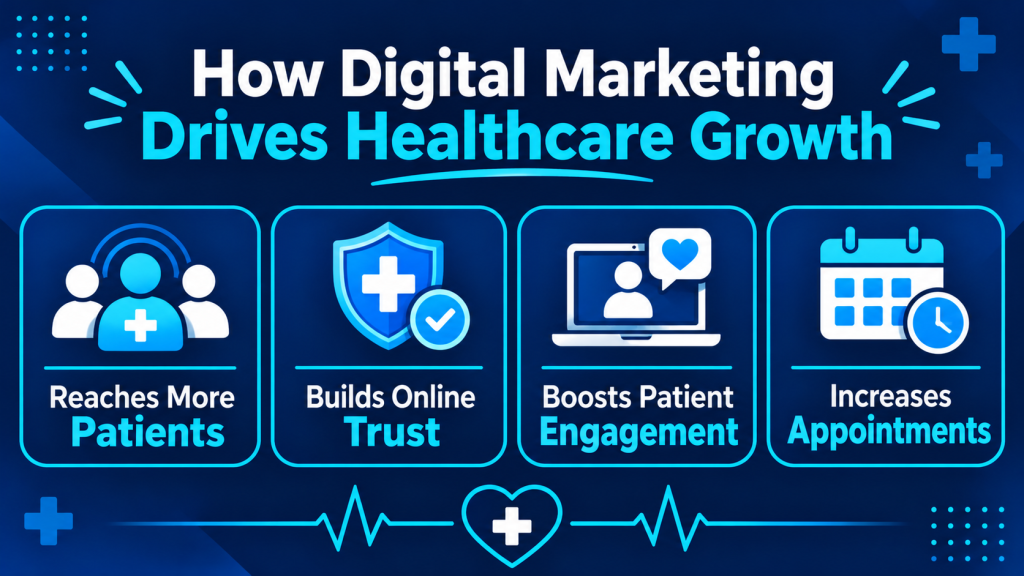
A strong online presence can help healthcare businesses reach more people. However, each digital channel plays a different role. The best approach combines these channels to create a smooth experience.
Let’s look at the main ways digital promotion can support your healthcare brand.
1. Improve Your Website and Online Presence
Your website is often the first place where people learn about your healthcare services. Therefore, it should look professional, load quickly, and provide clear information.
Visitors should easily find your services, doctor profiles, contact details, location, and appointment options. Also, your website should work properly on mobile phones because many people search for healthcare services through their phones.
A well-developed website can help you:
- Present your services clearly.
- Share doctor and specialist profiles.
- Make appointment booking easier.
- Answer common patient questions.
- Build confidence in your brand.
2. Use SEO to Reach People on Google
Search engine optimisation helps your website appear when people search for healthcare services. For example, someone may search for a heart specialist, dental clinic, or hospital near their location.
With proper keyword research, useful website content, and technical improvements, you can improve your chances of appearing in relevant search results.
This is where healthcare digital marketing becomes valuable. It helps your brand reach people who are already looking for medical information or services.
You should focus on:
- Service-related keywords.
- Local search terms.
- Helpful health articles.
- Clear service pages.
- Website speed and mobile experience.
3. Run Targeted Google and Social Media Ads
Organic marketing takes time. However, paid advertising can help you reach your audience more quickly.
Google Ads can show your services when people search for relevant terms. Meanwhile, social media campaigns can help introduce your brand to a wider audience.
For example, a hospital may promote a new diagnostic facility. Similarly, a dental clinic can run a campaign to introduce its services and encourage people to visit its website.
A good digital advertising campaign should include:
- A clear campaign goal.
- Relevant ad copy.
- A suitable landing page.
- A controlled budget.
- Regular performance checks.
4. Share Helpful Content on Social Media
Social media gives healthcare brands a chance to communicate with people regularly. You can use Facebook, Instagram, LinkedIn, and YouTube to share useful updates.
For example, you can post simple health tips, introduce doctors, explain medical services, and share hospital updates.
Moreover, short videos can make complex topics easier to understand. A doctor can explain basic health advice in a short video, while a carousel can break down a topic into simple steps.
The aim should be to educate and inform people. Avoid making every post look like an advertisement.
5. Build Trust Through Patient Reviews
People often check reviews before choosing a hospital, clinic, or doctor. Therefore, your online reputation matters.
Encourage patients to share honest feedback through suitable channels. Respond to reviews politely and address concerns in a professional way.
However, never share private patient details in public replies. Healthcare businesses must protect patient privacy at every stage.
How to Build a Digital Marketing Strategy for Healthcare?
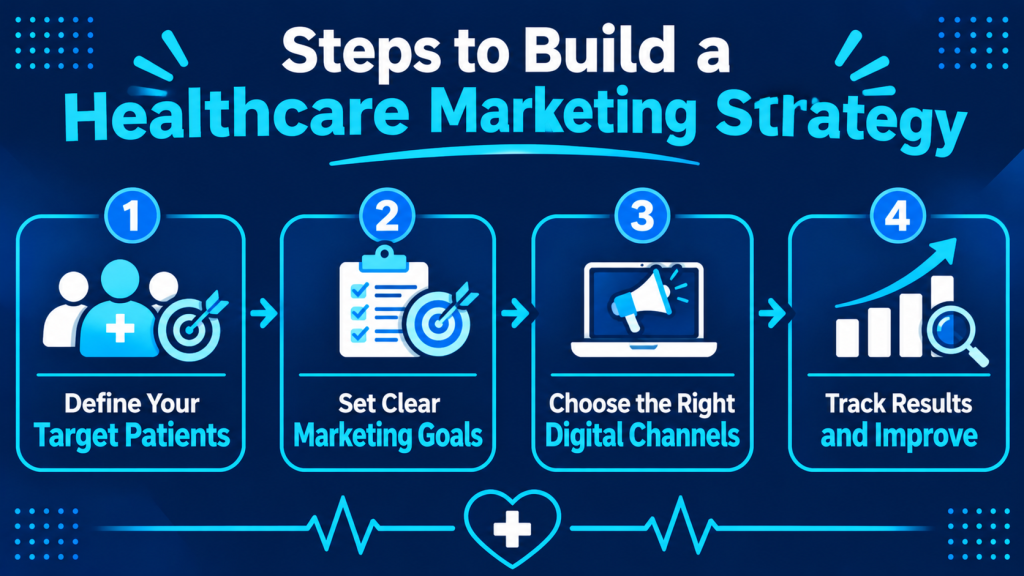
A successful campaign needs more than random posts and advertisements. You need a clear plan that matches your business goals and audience needs.
Here are some simple steps to get started.
Step 1: Set Clear Marketing Goals
Decide what you want to achieve. Your goals may include:
- Increasing website visits.
- Improving Google rankings.
- Getting more appointment enquiries.
- Promoting new medical services.
- Building brand awareness.
Step 2: Choose the Right Marketing Channels
You do not need to use every platform at once. Instead, select channels that match your audience and goals.
For example, SEO can support long-term search visibility. Google Ads can help promote specific services. Meanwhile, social media can build awareness and keep people informed.
Step 3: Create Useful and Accurate Content
Content should answer real questions. You can publish blogs, service guides, doctor introductions, short videos, and frequently asked questions.
Make sure qualified healthcare professionals review medical information before publication. Also, use simple words so readers can understand the message without difficulty.
Step 4: Track and Improve Your Results
Review your marketing performance regularly. Check website visits, search rankings, enquiries, ad performance, and appointment-related conversions where tracking is appropriate.
These details help you understand what works and where changes are needed.
Why Healthcare Businesses Need Professional Marketing Support
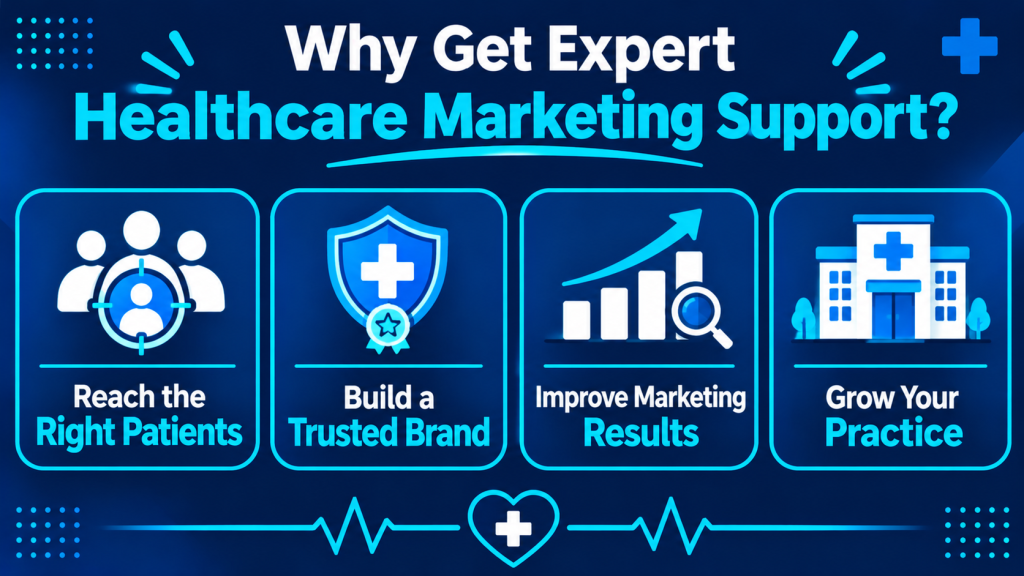 Healthcare businesses often have busy teams. Doctors focus on patients, hospital staff manage daily operations, and administrators handle important business tasks.
As a result, managing websites, ads, SEO, and social media can become difficult without proper support.
Professional healthcare marketing solutions can bring these activities together under one plan.
With the right agency, you can get support with:
- Website design and development.
- SEO and local search.
- Google Ads management.
- Social media marketing.
- Content writing and blog creation.
- Graphic design and video content.
- Campaign tracking and reporting.
Real Client Experience: Digital Services by TechBuzz
At TechBuzz, we work with businesses across different industries. Our experience includes search marketing, paid campaigns, website development, and social media management.
Here are three examples of our work across different sectors.
ShapeIn: SEO and Google Ads
For ShapeIn, our work focused on SEO and paid advertising. Both services play an important role in helping a business improve its online presence.
SEO supports long-term visibility through search engines. Meanwhile, Google Ads can help a brand reach relevant audiences through paid search campaigns.
Combining these services allows businesses to work on both organic growth and paid visibility.
Evercare: Website Development
A professional website is important for healthcare businesses because people often visit it before making a decision.
For Evercare, TechBuzz worked on website development. This type of project focuses on creating a clear and professional online platform where visitors can learn about the organisation and its services.
A well-planned healthcare website should make important information easy to find. It should also offer a smooth experience across desktop and mobile devices.
North Ravi: Social Media Marketing
Social media is a useful channel for building brand awareness and staying connected with an audience.
For North Ravi, our work focused on social media marketing. This service involves planning content, creating posts, and maintaining a consistent brand presence across suitable platforms.
These projects show how different digital services can support different business needs. The right solution always depends on the brand, its audience, and its goals.
Want This Applied to Your Brand? Contact TechBuzz
Your healthcare brand deserves a clear online presence and a marketing plan that supports real business goals. Our team offers SEO, Google Ads, social media marketing, website development, and content creation under one roof.
We focus on understanding your business first. Then, we suggest suitable services to help improve your online visibility and connect with the right audience.
You can also explore our Google Business Profile and business information to learn more about TechBuzz.
Conclusion
The landscape of digital marketing is ever-changing, now more than ever, and healthcare practices have got to be agile to keep up. Your audience has to be the key focus when devising your marketing strategies so the voice of your medical entity resonates with your target market. With the abundance of information readily available, it’s crucial to make use of data analytics to guide your strategy plan, so you know exactly what’s working and what’s not.
Want to grow your healthcare brand online? Contact us today and let our team help you plan the right digital strategy.
FAQs
How Can Digital Marketing Help a New Healthcare Clinic?
Digital marketing can help a new clinic introduce its services to people in nearby areas. A professional website, local SEO, Google Business Profile, and social media pages can make it easier for people to find the clinic. Moreover, helpful blogs and informative posts can answer common questions.
Which Digital Marketing Channel Works Best for Hospitals?
There is no single channel that works best for every hospital. It depends on the hospital's goals, services, location, and audience. For example, SEO can help people find hospital services through Google. Google Ads can promote specific departments, while social media can share updates and health information.
What Should Healthcare Brands Avoid in Online Marketing?
Healthcare brands should avoid misleading claims, false promises, copied content, and unverified medical information. They should also protect patient privacy and follow advertising rules. For example, never share patient photos, stories, or medical details without proper permission.