
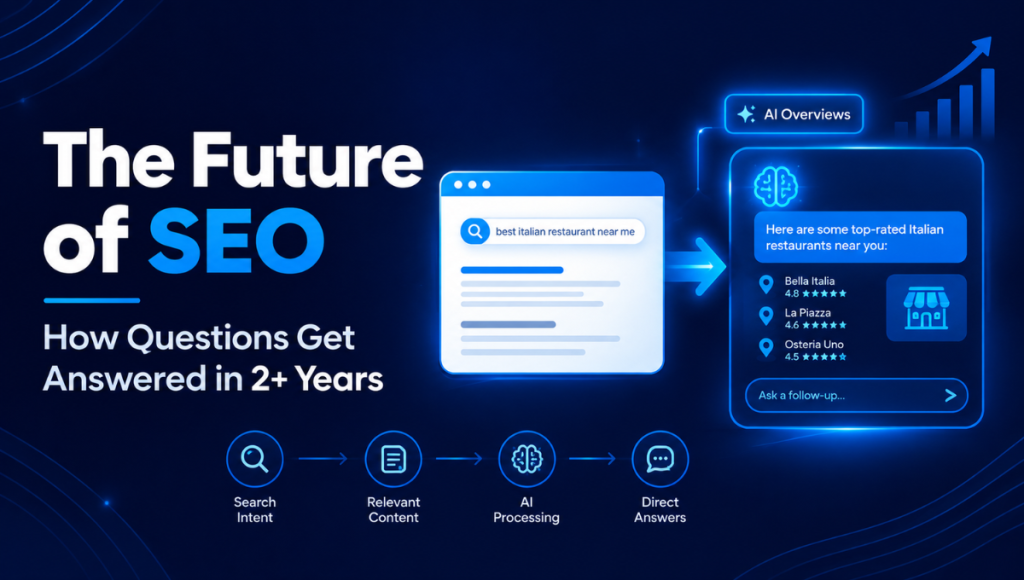
Summary: An AI-driven guide on the transformation of search from clicks to AI-driven responses, and on what companies should do to remain visible as SEO transforms into something else. The guide provides a detailed breakdown of the future of SEO, from AI Overviews to entity-based content strategies.
______________________________________________________________________
The Future of SEO: What Search Will Look Like by 2028
LLM SEO | AI Search Results | SEO Services
The future of SEO is in answers, not rankings. Rather than showing ten blue links, search engines increasingly come up with an answer right away. Businesses that used to measure their success based on ranking number one need a new way to calculate how successful they are. AI Overviews now appear in roughly 45-60% of all Google searches as of 2026 (Similarweb / Semrush Sensor), up sharply from under 16% in late 2025.
Despite this shift, Google’s overall search volume hasn’t shrunk. According to Alphabet’s Q1 2026 earnings report, Google Search queries actually hit an all-time high, with CEO Sundar Pichai crediting AI Overviews and AI Mode for driving that growth. It has actually grown alongside AI adoption, suggesting both formats are expanding the market rather than competing for the same searches. However, this trend does not mean that SEO is irrelevant; it just needs to evolve. For example, according to a report made by Rand Fishkin’s company SparkToro, out of 332 million Google searches, over 50% were people asking questions. And about a third of all searches were just people trying to find a certain website or page.
Where are We With AI Search Right Now?
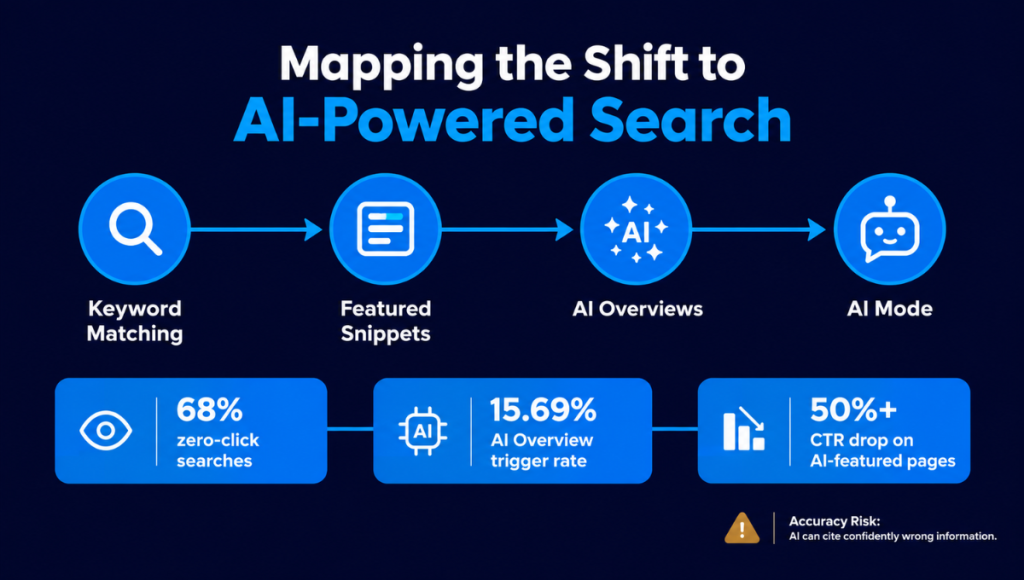
Search engines have progressed well past matching search queries with keywords.
The Move Towards AI-Powered Search Results
Search results are not limited to only links these days. Google has started integrating information from various sources into a single answer box. Hence, users can find what they are looking for without actually having to visit any website. Currently, around two-thirds of the searches on Google are zero-click searches in major markets.
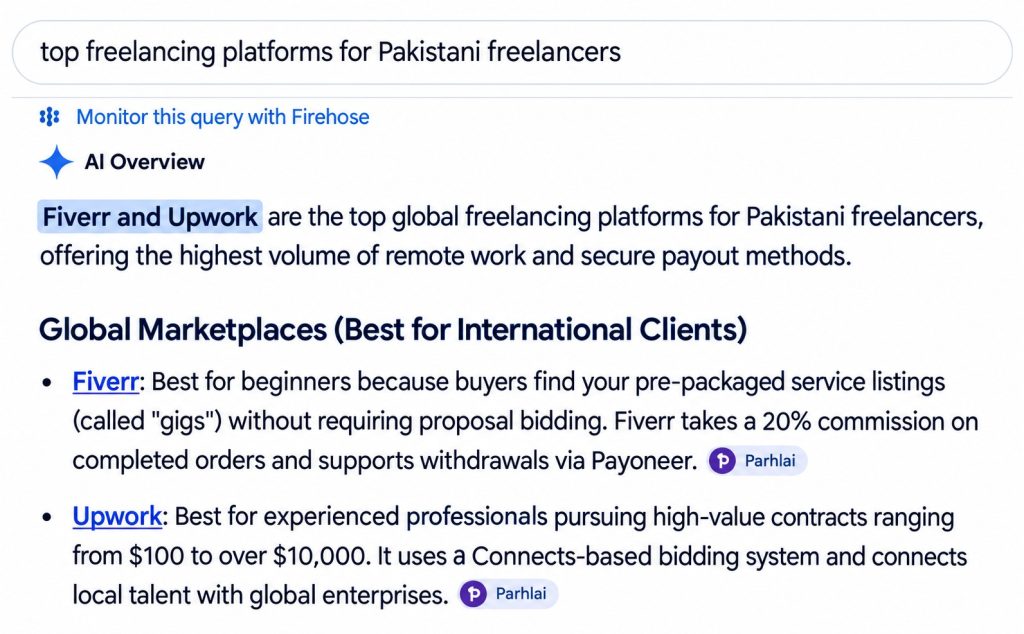
Google AI Overview for “top freelancing platforms for Pakistani freelancers”, September 24, 2026
Google’s Journey from One Step to Another
Google has not reached this position in just a short span of time. Featured snippets and knowledge panels have set the stage for many years. Then came AI Overviews, which provided full conversational answers based on those features. However, Google AI Mode takes the process to another level and handles multi-step queries as a chatbot does. Currently, AI Mode has around one billion monthly users globally. These changes are reshaping the future of SEO, and marketers need to adapt their strategies to stay visible.
Nonetheless, Google is far ahead in terms of scalability. Google Search connects with billions of active users globally, whereas ChatGPT, despite its rapid growth, continues to account for a smaller share of the overall search activity. In fact, total search activity — traditional search engines and AI chatbots combined — has grown by roughly 26% globally, showing that AI isn’t shrinking Google’s market but expanding the overall pie. The importance of this fact lies in the fact that conventional search is not going away, despite the quick growth of AI-based searches.
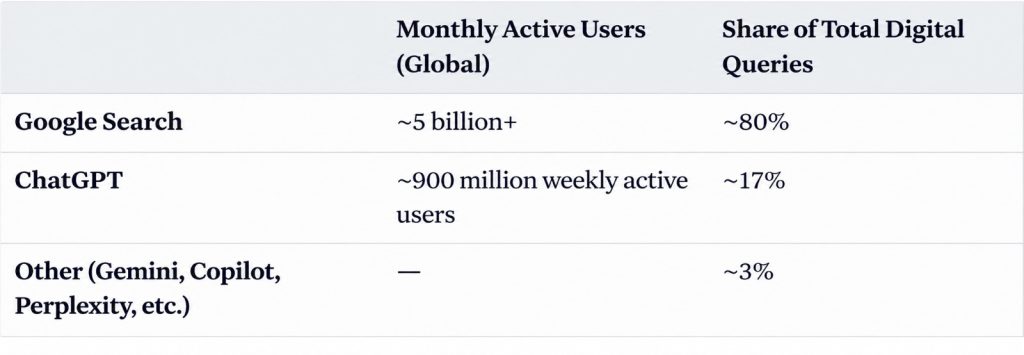
Source: First Page Sage, Q2 2026 estimate
Future of SEO: Implications of This Trend for SEO at Present
While conventional SEO strategies do have value, they alone won’t be enough anymore. Preparing for the future of SEO means optimizing for both rankings and AI citations. The page-one placement no longer provides the guaranteed number of clicks it used to before. Web pages that are featured in the AI Overviews suffer a CTR drop of more than 50% compared to the standard listing.
On the other hand, the brand that gets mentioned in the AI answer has a higher chance of performing better than the one that does not feature any citation. In the research by Semrush, the AI Overviews were featured in approximately 15.69% of all the Google searches by November 2025, having reached their peak in summer at about 25%. It is worth noting that with the addition of the AI Overview, the zero-click rate of the search terms in question slightly decreased from 33.75% to 31.53%, not the overall Google zero-click figure mentioned earlier.
Source: Semrush AI Overviews Study https://www.semrush.com/blog/semrush-ai-overviews-study
Accuracy Issues Surrounding AI Search
Answers generated by artificial intelligence can be inaccurate due to the use of outdated content or wrong interpretation of the context. This problem, known as hallucination, means AI models can state incorrect information with complete confidence.
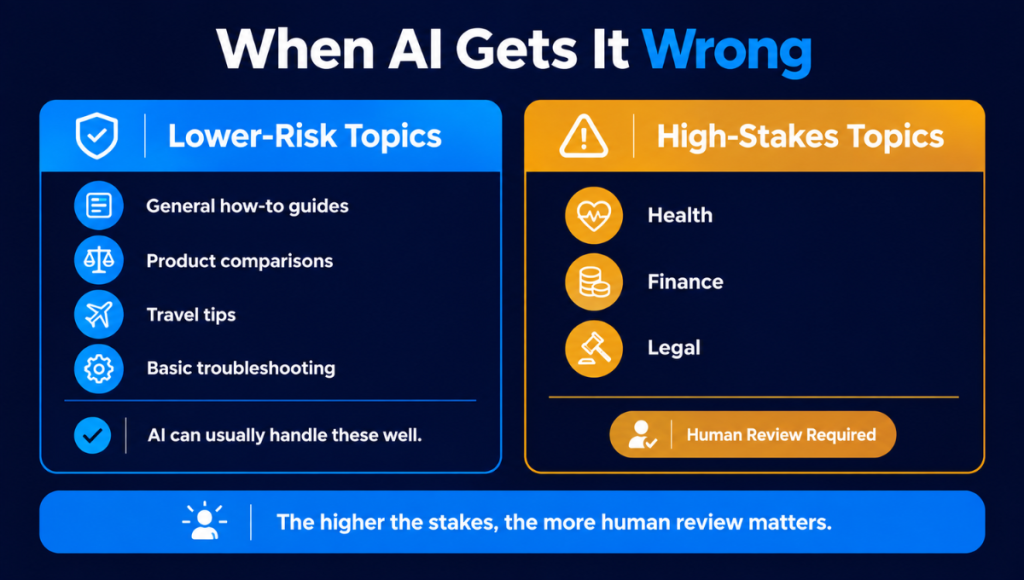
There are issues regarding trust when it comes to content about health, finance, or law — a confidently wrong answer in these areas could easily mislead a business decision. Companies should make sure that their content is unequivocal so that it is accurately represented by AI models. Human review remains essential before publishing anything AI helps produce, since misrepresentation will harm the reputation of the business beyond the scope of regular SEO optimization.
How to Adapt Your SEO Strategy for the AI Era
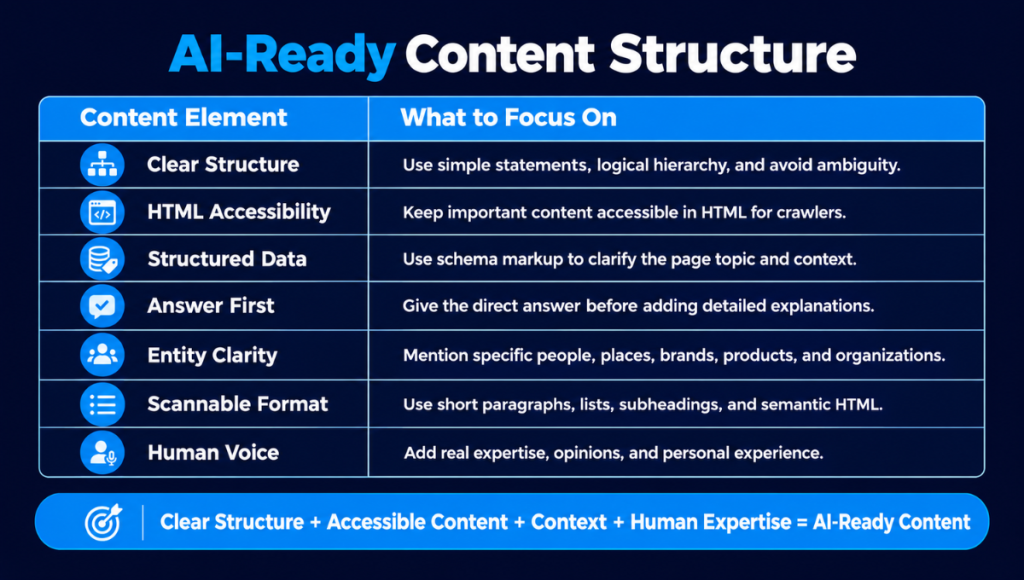
Being cited in AI models is something that should be done starting from structuring content at its initial stage.
Making Content Understandable for AI Models
AI models analyze content differently compared to humans. They need to see the structure, straightforward statements, and a hierarchical structure. Hence, it is crucial to avoid using ambiguous or tricky formulations in content optimized for AI search.
Why HTML Accessibility Is Important for Content
Content needs to be accessible through the page’s HTML to be indexed by crawlers. Content that requires JavaScript rendering or is placed inside images will most likely be missed. This is still a basic principle of SEO, while everything else is being changed by AI.
The Importance of Structured Data
Structured data serves as an interpreter for your content and search engines. Adding schema markup will allow AI systems to know what the topic of the page is. FAQ schema, product schema, and article schema serve precisely this purpose. Otherwise, AI will have to guess about the context, which it should be able to read.
Answer First, Explain Later
This rule becomes especially important in the time of AI-based systems. Both readers and AI models will appreciate the directness of your answers. A long introduction that precedes the answer can lose both. However, after answering, you can give further explanations to it.
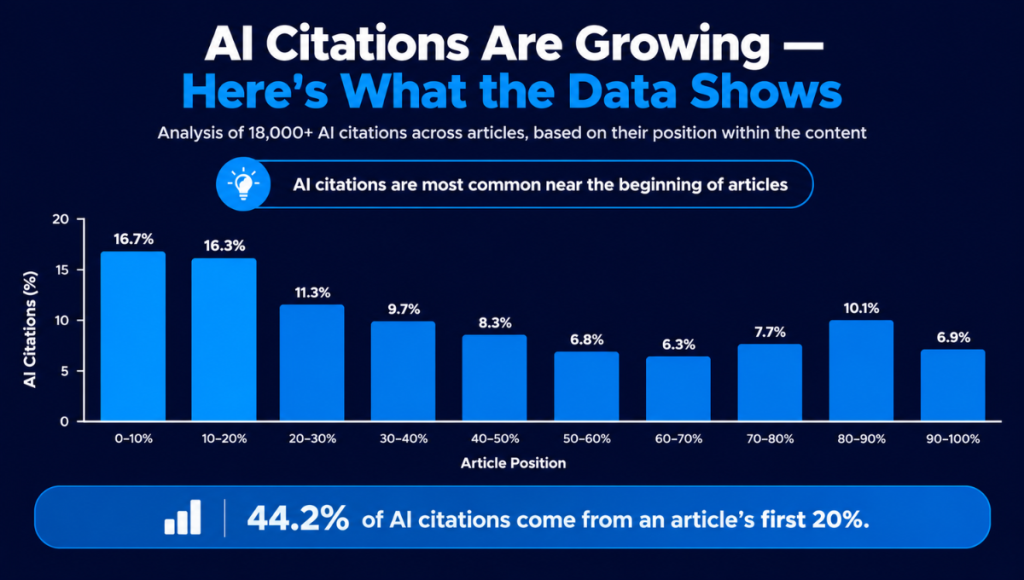
Research shows 44.2% of AI citations come from an article’s first 20% — reinforcing why leading with the answer matters more than ever (Source: Growth Memo/Gauge, 18K+ citations analyzed)
Clear Identification of Entities
Identifying entities will aid search engines in making the connection between your content and tangible objects. Instead of being vague about your topic, always mention specific people, places, product names or brands, and organizations. This type of approach, called entity SEO, makes AI systems cite your content with more confidence.
Structured Format
Semantically formatted HTML and clean formatting help both humans and machines to easily understand your content. Lists, short paragraphs, and subheadings increase scannability. Also, using this kind of format facilitates section extraction by AI systems.
Maintain a Human Voice in Your Content
While all of the above is good to do, it is important to have a human voice speaking through your content. Machine writing often sounds empty even when written optimally. Real expertise, opinions, and personal experience are something that cannot be replicated by AI.
Going Beyond Traditional Search Rankings in Terms of Visibility
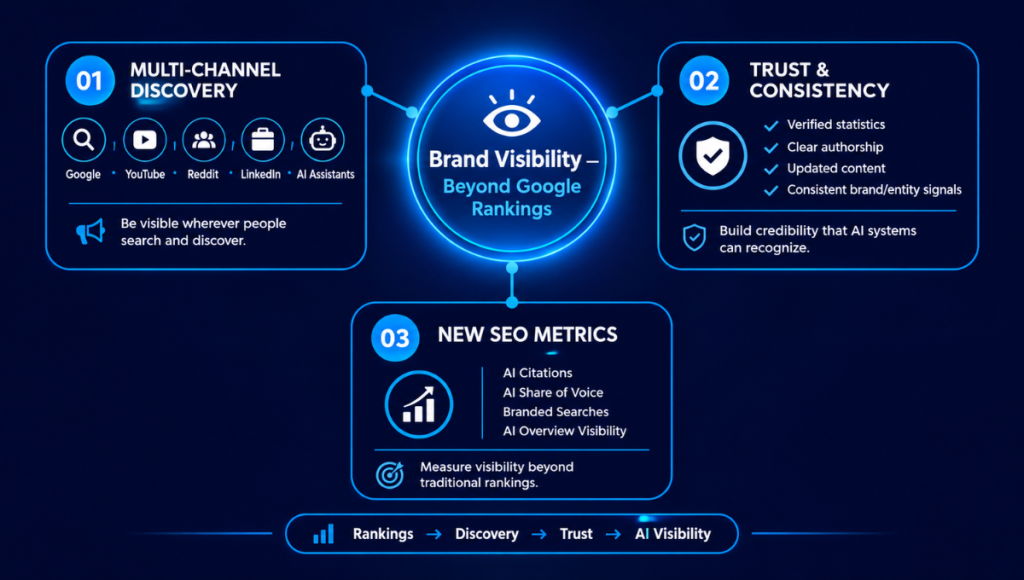
The ranking on Google is not an endpoint anymore. Real visibility goes much further than that.
Building Visibility Beyond Google
It is true that Google is the largest search engine out there. Still, it is no longer the only way of discovery that exists. Nowadays, people look for answers to their questions on YouTube, Reddit, LinkedIn, and even artificial intelligence assistants. Making your brand visible through more platforms helps you secure its visibility even as habits evolve. If a company relies only on one discovery channel, it makes itself vulnerable to changes in algorithms.
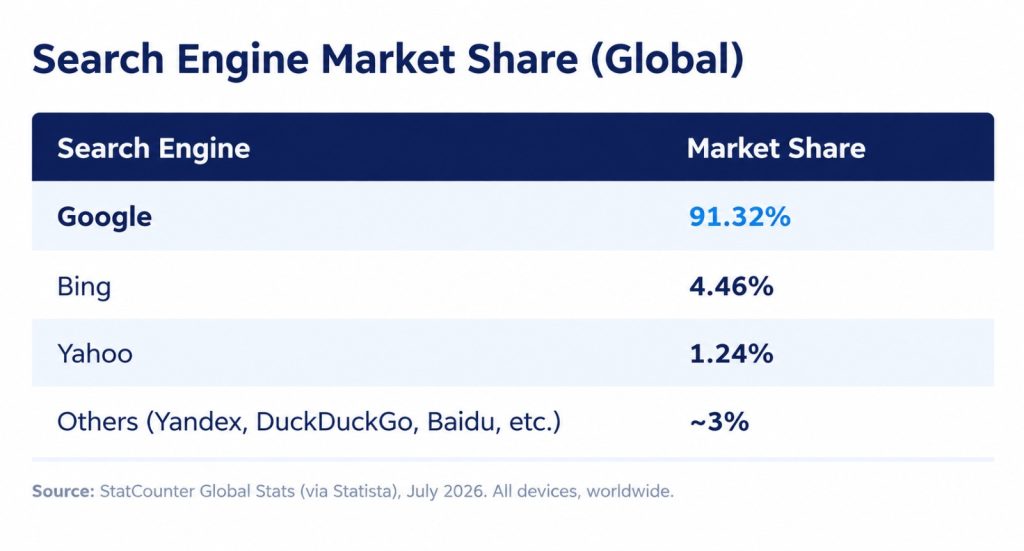
Source: StatCounter Global Stats, July 2026 (global, all platforms)
Visibility Through All Discovery Channels
Optimizing for various discovery channels requires adaptation of the content to each individual format. A video on YouTube, a post on LinkedIn, and a blog post are all created in different formats. However, they can all be related to one and the same idea and entity signals.
Building Trust by Providing Verified and Consistent Content
The more a source shows itself to be accurate and trustworthy, the more AI systems prefer such resources. Providing credible statistics, mentioning authorship, and removing old content can help achieve that effect. Brands that are recognized as credible sources become quoted more frequently in AI-created responses. In the long run, such consistency becomes authority in a specific topic.
Measuring the Results Using Updated SEO Metrics
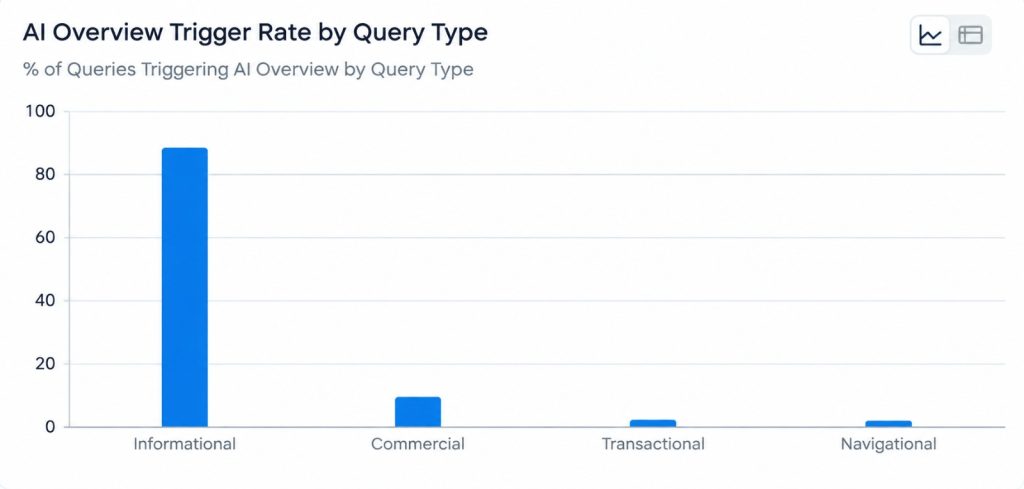
The amount of traffic is not enough to assess SEO performance anymore. The new metrics include citation volume, share of voice in AI responses, branded search increases, and others. It is impossible to track these signals using only ranking tracking tools. This shift isn’t limited to informational content either — commercial searches are seeing some of the fastest AI Overview growth, with certain industries like finance seeing far sharper increases than others. Companies which will change their reporting in time will have an advantage in SEO.
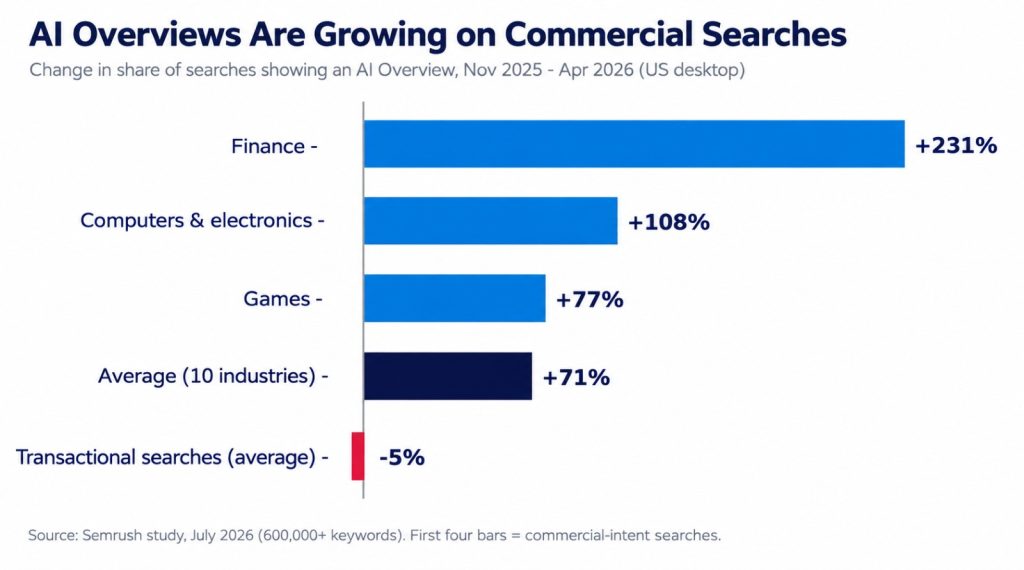
AI Overviews are expanding fastest in commercial categories like finance, while transactional searches remain largely unaffected. (Source: Semrush, July 2026)
TechBuzz Approach: Expert-Led Services, AI-Enhanced Where It Matters
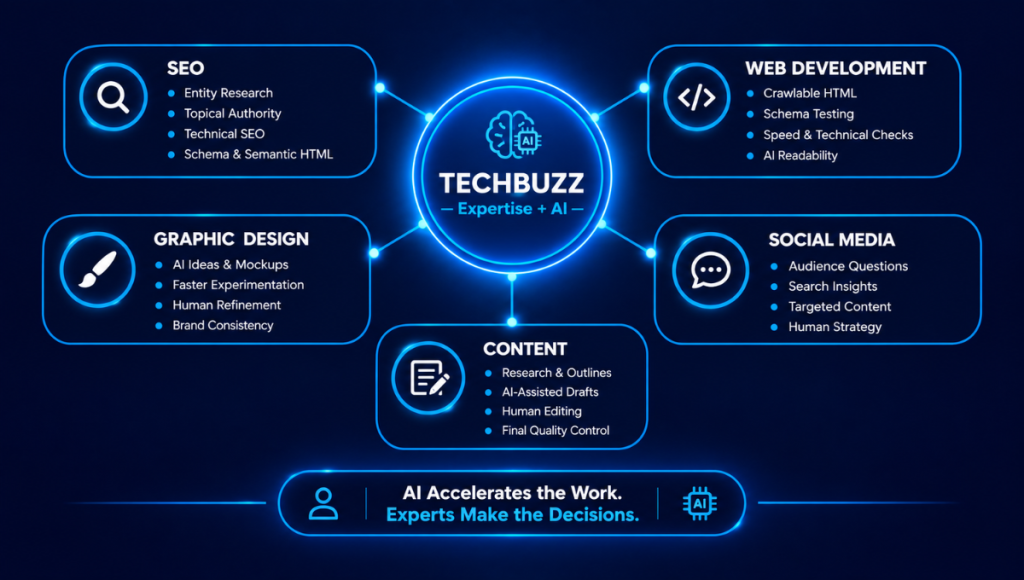
At TechBuzz, results are achieved through experts, and AI is an additional instrument that allows our teams to work more effectively, not a substitute for experience. This human-led, AI-assisted approach is how TechBuzz prepares clients for the future of SEO. Below are ways that every team combines their knowledge with AI.
SEO
SEO specialists are experts who have a lot of experience in entity research, topical authority mapping, and technical optimization. AI allows our team to go further and to save time on tasks like identifying entity connections and content gaps, but every strategy created by our team is based on their own understanding. Each page on our website has a schema, semantic HTML code, and entity markup to succeed in traditional search and be mentioned in AI systems. This balance of human expertise and AI-powered efficiency is what shapes modern SEO success.
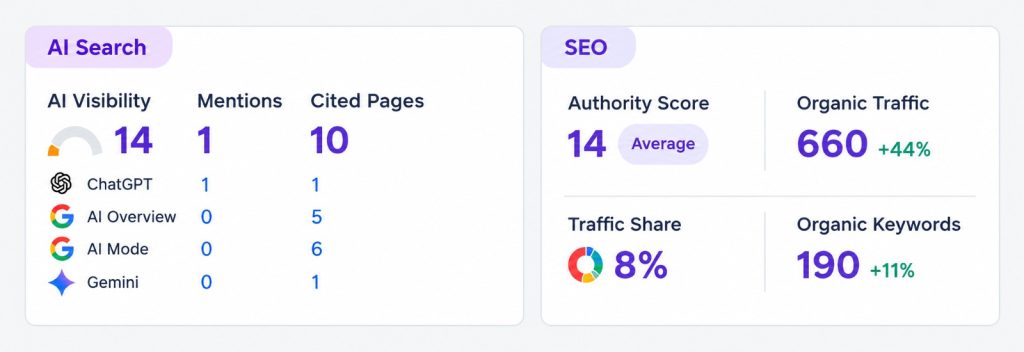
TechBuzz’s own domain is already being cited across ChatGPT, Google AI Overview, and AI Mode — with organic traffic up 44% (Semrush, August 2026)
Web Development
Our developers create webpages that have crawlable HTML from the start, with no obstacles in reading information by AI programs and conventional search bots. We use AI testing to find any issues with the website, such as slow load speed or problems with schema, both of which will affect the way AI algorithms interpret the page.
Graphic Design
The team utilizes AI technology to come up with ideas, mock-ups, and visualizations faster, meaning that we can experiment with more creative ideas. In turn, all of those will be fully revised by humans so that there is no hint of AI style in the end result.

An AI-generated concept (left) refined by our design team into a final, brand-consistent design (right).
Social Media
The team uses AI to determine the exact questions or searches that audiences may have. Content creation based on these questions allows our social media strategy to be much more targeted. Human strategists decide how and where the content should be placed on social platforms.
Content
Our content team covers both written and video content. Writers use AI to speed up research, structure outlines, and put together first drafts, while video creators use AI to quickly generate scripts, explore concepts, and speed up editing steps like captions and rough cuts. In both cases, every piece is then reviewed and finished by our team — writers polish the tone and accuracy of each post, and video creators fine-tune pacing, visuals, and final edits — to make sure the final output meets our standards and doesn’t feel AI-made.
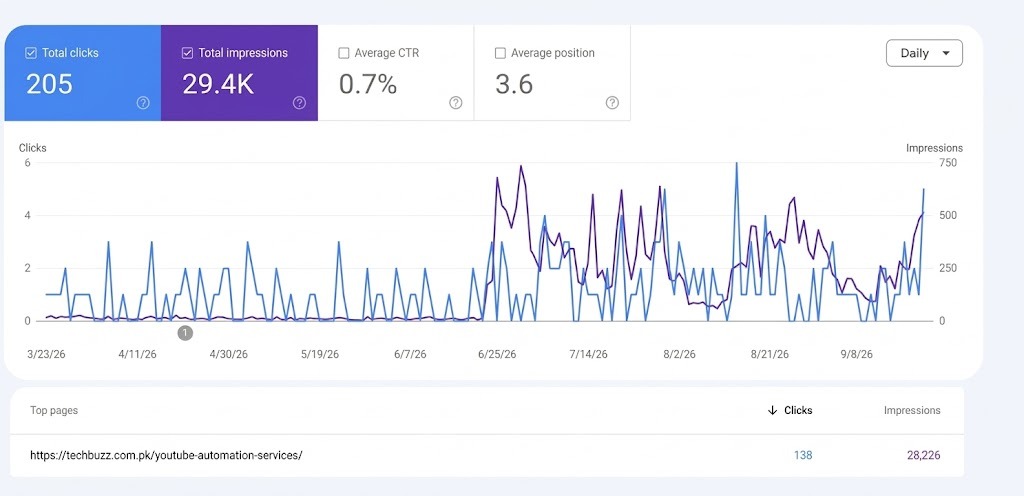
Our content team took this page from near-zero visibility to a top-3 average Google position within months — now averaging position 3.6 with 29K+ monthly impressions (Google Search Console, Mar–Sep 2026).
Conclusion
The future of SEO is not about turning away from past successes, but about building upon an existing base with new methods. Structured content, defined entities, and multi-channel visibility are just as important today as keyword optimization was once. Companies that are able to adapt early will be visible even as more answers are provided directly within the results pages. Is SEO dead? No way – although it’s changing faster than many plans take into consideration. If you’re ready to future-proof your SEO strategy, get in touch with our team today.
Whether you need a technical SEO audit or a complete content strategy, explore how we approach these challenges on our blog.
Frequently Asked Questions
Is SEO dead with the introduction of AI search?
No, SEO is not dead, but it’s evolving. Rankings are important, but citations within AI results are equally important. Companies must implement both SEO techniques simultaneously. Failing to do so would mean losing visibility on both fronts.
What is entity SEO and why is it important?
Entity SEO helps search engines understand precisely what your content is talking about. Entity SEO is the process through which you can connect your brand with actual topics and concepts. It helps in making sure that your content is cited with confidence by the AI system.
How can local SEO services in Pakistan help in this transition?
Local SEO services in Pakistan can help you make your content fit into regional search trends. Along with it, they can ensure that your content has solid foundations to rank for both types of searches.