

Summary: If you have been following every SEO update 2026 has brought so far, this one stands out. It is the fourth spam update of the year, after releases in March, June, and August. Each of those earlier updates finished in about three days or less. This time, Google has given itself a window of up to two weeks. This is a practical SEO conversation rather than another “Google Update is here, panic now” article. Let’s dive in:
Google Spam Update September 2026: Everything You Need to Know
Google Spam Update 2025 | Best SEO Services | Digital Marketing Agency
A lot is happening in the SEO world, and Google has done it again.
Yes, you are right!
Another update: Spam Update
This time, SEO teams have a little longer to watch rankings move.
Google began rolling out its September 2026 Spam Update on September 24, 2026, and the company says the rollout may take up to two weeks. The update applies globally and across all languages. As of September 29, Google’s Search Status Dashboard is still showing the update as active and affecting rankings.
But here is the part that matters: Google has not said that this update targets one specific spam technique.
So, if your rankings suddenly move, don’t immediately blame AI content, backlinks, location pages, or any other single tactic. Google has confirmed that this is a spam update, but it has not published a detailed list of exactly what changed inside its systems.
That distinction is important.
What is the September 2026 Google Spam Update?
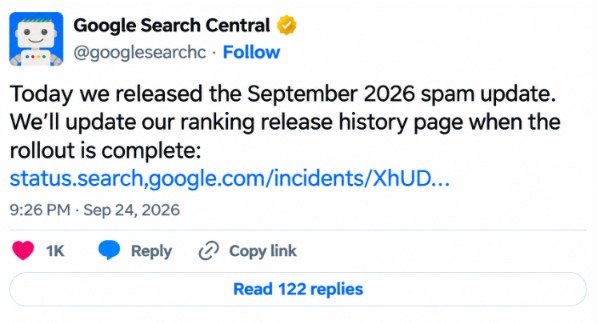
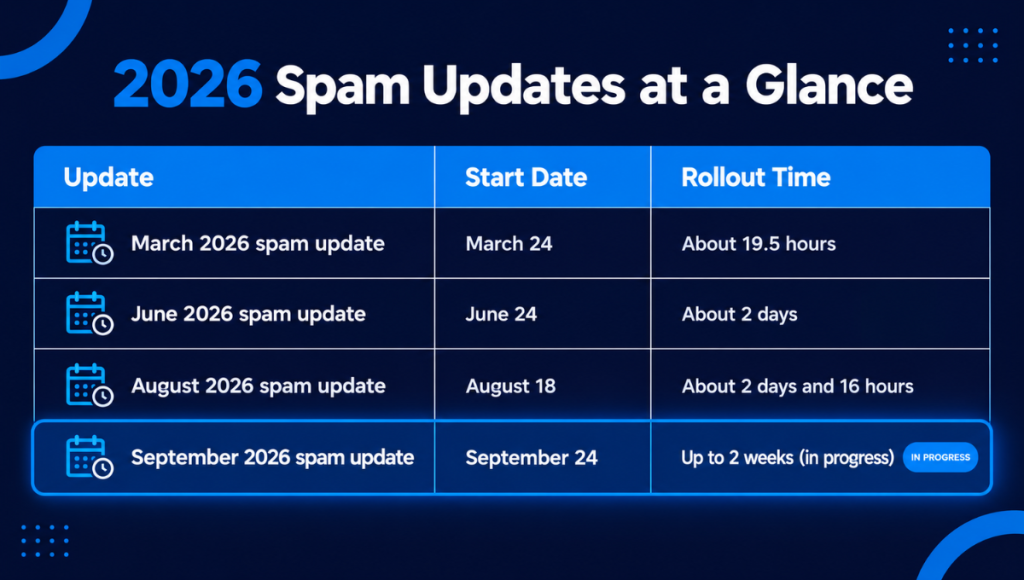
The September 2026 Spam Update began on September 24. This is the fourth confirmed Google spam update of 2026. As we know, this whole year was all about updates in March, June, and August.
The previous 2026 spam updates moved much faster:
- March 2026: about 19 hours and 30 minutes
- June 2026: about 2 days and 1 hour
- August 2026: about 2 days and 16 hours
- September 2026: potentially up to two weeks
What Has Google Actually Said About This Update?
Google’s official announcement is surprisingly short.
Google confirmed that the September 2026 spam update:
- Started September 24, 2026
- Applies globally
- Applies to all languages
- Is a normal spam update
- May take up to two weeks to complete
- Affects Search ranking systems
SEO Experts Are Already Talking About the Update
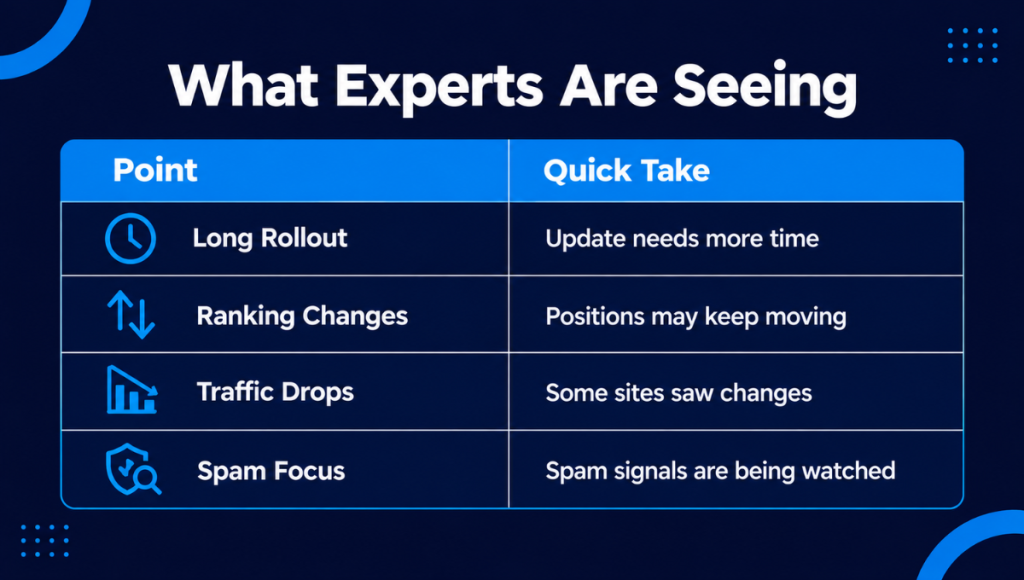
The SEO community has been watching the rollout closely.
John Mueller: The Two-Week Rollout Is Not a Typo
Barry Schwartz of Search Engine Roundtable asked John Mueller from Google about the unusually long rollout period. Mueller confirmed that it is likely to take longer than some of the previous spam updates.
That’s useful because it confirms that the two-week timeframe was intentional. This also gives website owners a reason to be patient. If rankings move around during the rollout, today’s position may not be the final picture.
He also responded to a Reddit report of pages leaving Google’s index while an unrelated casino site appeared as their canonical.
Barry Schwartz: Expect More Movement During the Rollout
SEO journalist Barry Schwartz has been closely tracking the update through Search Engine Roundtable and Search Engine Land.
In his September 28 coverage, Schwartz reported significant volatility over the September 25–27 weekend and noted that the exact target of the update was still not fully known.
That is an important observation.
In other words, even experienced SEO professionals do not yet have a complete answer to “What exactly did Google change?”
So don’t trust anyone claiming they have a secret one-line explanation for the entire update.
Which Websites Could Be at Higher Risk?
The update is not officially limited to one industry or website type. However, websites that use practices covered by Google’s spam policies deserve closer attention.
For example:
- Websites publishing huge numbers of low-value pages
- Sites copying or lightly rewriting other websites’ content
- Affiliate sites that provide little original value
- Websites creating pages for hundreds of nearly identical locations
- Sites using deceptive redirects or cloaking
- Websites using hidden text or keyword stuffing
- Sites buying or building manipulative backlinks
- Websites using expired domains primarily to exploit their old reputation
- Large sites hosting unrelated third-party content mainly to benefit from their established ranking signals
Why Could Some Websites Lose Search Visibility?
Google Search is competitive. If one page moves down, another page can move up.
So when spammy or policy-violating results are demoted, other pages may gain visibility simply because the search results have changed.
For example:
Google has ten results for a competitive query. If several low-value pages are removed or demoted, pages that were previously below them can move higher.
That does not necessarily mean Google has “rewarded” those sites with a special bonus. Their relative position may simply improve because other results have changed.
This is why a website can gain traffic during a spam update even if the site itself made no major SEO change.
Doorway Pages and Mass Location Pages
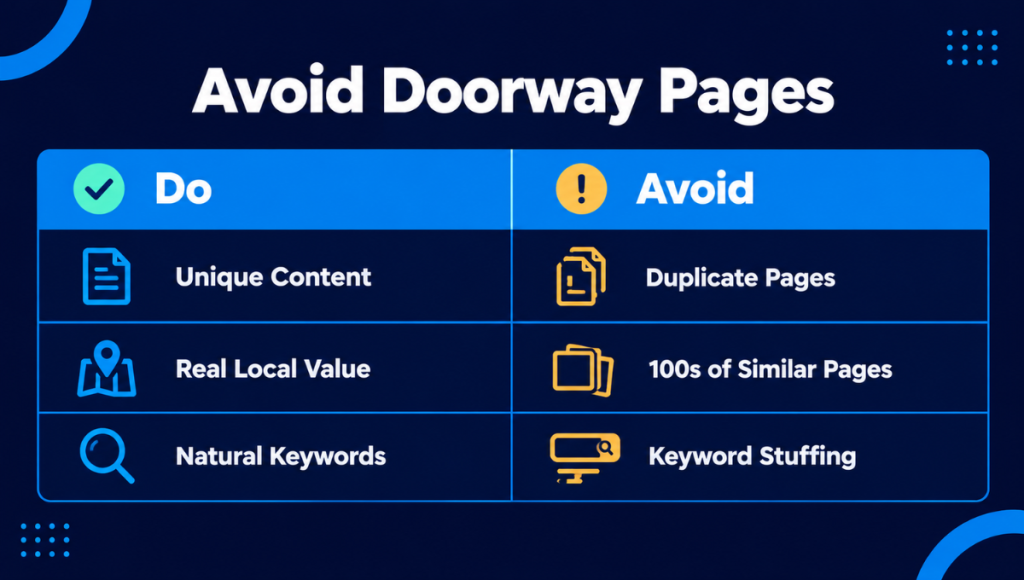
Google wants searchers to land on pages that answer their questions. When a site breaks Google’s spam policies, it can rank lower or drop out of results entirely. Sites that follow the policies are not the target.
Location SEO can be useful.
But creating hundreds of pages with almost identical content just to rank for city names can cross into doorway abuse or keyword stuffing territory.
Google’s examples include pages targeted at specific regions or cities that funnel users toward one final destination.
For example:
- /plumber-lahore
- /plumber-islamabad
- /plumber-karachi
- /plumber-rawalpindi
- /plumber-multan
If all five pages contain essentially the same content and simply swap the city name, ask whether each page genuinely helps a local visitor.
A useful local page could instead include genuinely relevant information such as:
- Services available in that area
- Actual service coverage
- Local customer information
- Relevant business details
- Local regulations or considerations
- Real photographs or examples
- Genuine location-specific FAQs
Expired Domain Abuse: Don’t Buy an Old Domain Just for Its Reputation
Buying an expired domain is not automatically against Google’s rules. The problem occurs when someone buys an old domain primarily to exploit its previous reputation and then places unrelated low-value content on it.
Google gives examples such as:
- An old government-related domain becoming a low-quality affiliate site.
- A former nonprofit medical site becoming a commercial medical-products website.
- An old school-related domain becoming a casino-content site.
The common idea is simple:
Old domain reputation + unrelated low-value content + ranking manipulation = potential expired domain abuse.
Using an old domain for a legitimate new business or genuinely useful project is a different situation.
Spammy Links: More Backlinks Are Not Always Better
Backlinks still matter, but manipulating links is a completely different game.
Google’s spam policies cover practices such as:
- Buying links specifically to manipulate rankings
- Excessive link exchanges
- Automated link creation
- Low-quality directory links
- Keyword-rich manipulative links
- Sitewide template links
- Manipulative guest-post links
- Forum-comment links created mainly for ranking
- Other links created primarily to influence Search
This is why “Get 1,000 backlinks overnight” is not an SEO strategy worth celebrating.
A smaller number of relevant, editorially earned links can be much more meaningful than a giant pile of artificial links.
And remember: Google has not said that the September 2026 update is specifically a link spam update.
So don’t suddenly remove every backlink because your rankings moved this week.
Investigate first.
What Should You Check in Google Search Console?
During the September rollout, your Search Console checklist should include:
Performance report
Compare:
- September 1–23
- September 24 onward
- The same period from previous weeks
- Important pages individually
Queries
Find which search terms lost clicks or impressions.
Pages
Check whether the decline is:
- Sitewide
- Category-specific
- Template-specific
- Limited to certain URLs
Indexing
Make sure important pages remain indexed.
Manual Actions
Check whether Google has reported a manual spam action.
Security Issues
If you suddenly see strange URLs, redirects, or unexpected content, check for hacking or security problems.
URL Inspection
Inspect important pages that suddenly disappear or lose visibility.
The Big SEO Lessons to Take Into 2027
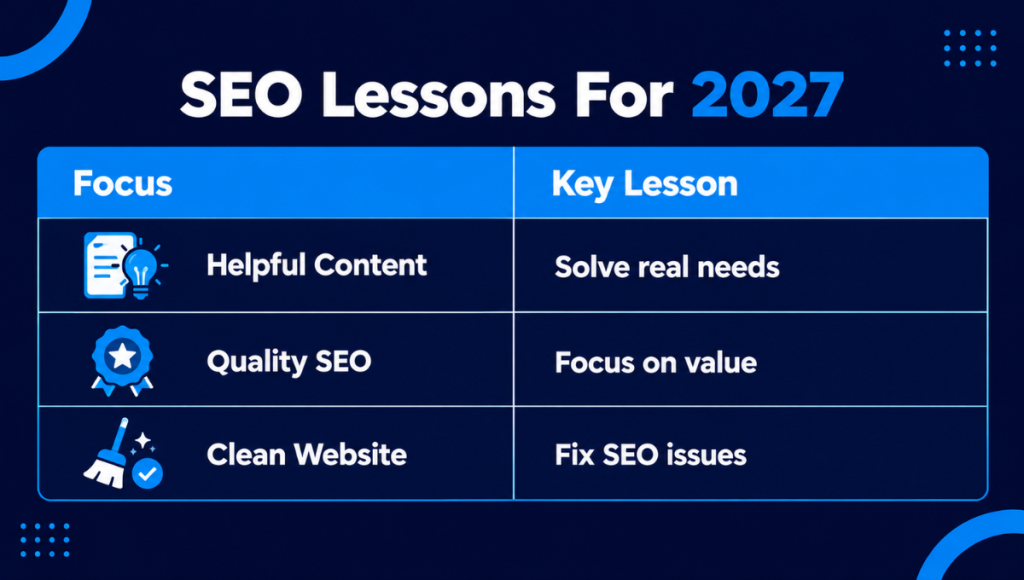
The September 2026 spam update teaches the website owner one thing: never build your SEO strategy around loopholes. Whenever you make a website for your business, make sure it has a proper SEO strategy to keep you ranked even if Google gets hundreds of updates. Google’s 24 September 2026 spam update is rolling globally, and according to Google, it may take up to two weeks. This means that with the previous spam system changes, websites are now at risk, especially those designed tactically.
Over time, SEO and AI are getting more updated, and they are becoming more specific about the user query. Competitors are posting more content, and now people are also good at searching for queries related to their problem. What remains is the way you can help people to view your website. In 2027, instead of building shortcuts to make your website rank, do SEO around quality, originality, trust, usability, and sustainable website practices.
-
Original information
Many new business owners think that they can just post information by copying it from other websites and get top-ranked. In today’s world, it is like living in delulu, cause now every user wants to get real information instead of copy-paste information. Your website should have content that shows it is based on firsthand experience or it has some value that other websites don’t provide.
To make your content more authentic, you can add examples, comparisons, case studies, photographs, expert commentary, or your real research. If your content is based on this, Google will lead people to your website. Always try to give authentic information so that the viewer gets some real information that he can’t find on the other 5 websites.
-
Real expertise
Now people are getting wiser and wiser, and also Google keeps updating itself. So just posting content is not the strategy to keep your website top-ranked. Now you need to add real content, which makes the user stop and dive into it. If you add a real example, it would be much better than just giving random imaginary stuff.
It is most important if your business is so sensitive that minor negligence causes big trouble, like if you have a finance or industrial website; you need to keep values and prices accurate. This way, your viewers trust you more, and your website gains traffic.
-
Helpful user experiences
Most of the website’s pages have a lot of ads when a viewer checks them. This causes the viewer to lose interest and move to the next website. Your website page should be clear enough that even a single glance helps the user help him understand that he is in the right place. He should get the answer to the question: Is this page worth it? Does it answer my question, or what should I do next? If your page gives this information, your viewer is not going anywhere.
A strong page should be easy to scan, readable on mobile devices, and structured around the user’s actual task.
Final Takeaway: Don’t Panic—Contact TechBuzz Now!
September 2026 causes a lot of trouble for all business websites. As Google released a new update, which is a spam update, most of the websites are losing their rank. So this update does not mean that the SEO picture is finished; you can still make your website top-ranked with the help of Techbuzz. We will check your website and find the SEO issues, and then we will give you detailed strategies to help your website grow and get traffic.
Instead of panicking and thinking that your website is drowning, you need to hire an SEO team that helps your website rank again. Our team is highly experienced and knows how to keep your website at the top while giving you good traffic. If you need help with your website, you can contact us anytime. Then it’s our duty to give you the best SEO service and create a plan that will help your website to be ranked again.
Frequently Asked Questions
What is Google's spam policy?
The basic policy of Google's Spam Update is to help users keep them away from fake content. It basically hides or keeps websites out of reach of users that have low-quality content or copy-based content.
Does a traffic drop mean my site has a penalty?
No, traffic drops mean that your website is losing its rank, and you need to work on its SEO strategy. Updates keep rolling throughout the year, and fluctuations occur, but you need to keep your website updated with new updates to keep it a top-ranked website.
Does Spam Update target a specific new policy or AI content?
No, Google confirms there is no specific new policy for a blanket ban on AI content. It just keeps the search results good for the user and keeps websites out of reach that have low-quality content posted or do not have authentic information about the things they are talking about.