
Website crawling is the foundation for how search engines like Google locate, understand, and rank websites. Crawling in SEO refers to the process by which search engine bots systematically scan web pages to gather information. In this process, bots systematically scan web pages, index their content, and evaluate their relevance to search queries. When you optimize your site for crawlability using internal linking, sitemaps, and fast loading times, you help search engines find your pages more easily and rank them higher in search results. Technical SEO and frequent updates are necessary for visibility because AI advancements have made it possible for search engines to comprehend content more intelligently. In summary, effective crawling optimization is essential for better user experience, higher rankings, and long-term online success.
____________________________________________
The Role of Website Crawling in SEO: How Search Engines Find Your Site
Google Analytics | Search Engines | Screaming Frog
1. What is Website Crawling in SEO?

Website crawling is the process by which search engines, like Google, Bing, or Yahoo, send automated programs known as crawlers, spiders, or bots to browse websites throughout the internet. These bots “crawl” web pages by following links from one page to another, learning about the links, content, and structure of each page.
Search engines use crawling to locate and understand your website. Crawling in seo plays a crucial role by allowing them to discover and index your content. Your website wouldn’t show up in search results since search engines wouldn’t know it existed without crawling.
For instance:
Consider Google’s crawler to be the librarian of the internet, which is a vast library with billions of books. Before noting the subject matter of each book, the librarian glances at each shelf, quickly flipping through the pages and reading the titles. The librarian can quickly locate the most pertinent books to show someone when they ask for a specific topic later.
The crawler saves the information it finds after scanning web pages so the search engine can access it later. Crawling is exactly like that.
2. The Three Primary Steps in the Operation of Search Engines

Crawling, indexing, and ranking are the three primary functions that search engines perform to deliver users with relevant results.
Let’s dissect each step.
First Step: Crawling
This is the stage of discovery. In this crawling process, search engines use crawlers, such as Googlebot, to locate fresh and updated web pages. Beginning with a list of well-known URLs, the crawler finds new URLs by clicking on links on those pages. During website crawling, it logs important details about the pages it views, including:
- Titles of pages
- Meta descriptions
- Links both internal and external
- Alt texts for images
- Keywords and headings
The easier it is for bots to crawl your site efficiently, the more accessible and organized it is.
Step 2: Indexing
Following their crawl, search engines analyze and store the data they discover in an index, which is a sizable database. Imagine it as a digital library with each web page arranged according to its content.
When indexing, search engines look at:
- Keywords and page content
- Pertinence to the user’s intention
- Schema markup and meta tags
- Mobile friendliness and page speed
A page can show up in search results if it is successfully indexed. No matter how good the content is, it won’t show up if it isn’t indexed.
Step 3: Ranking
Search engines use hundreds of criteria to rank pages after they are indexed, determining which ones should show up at the top for particular queries. These elements consist of:
- Relevance of keywords
- Quality of page content (mobile device usability, speed)
- Backlinks (quantity and quality)
- Metrics of user engagement (bounce rate, click-through rate)
Your SEO efforts will start to pay off at this point. How visible your website is to people looking for your keywords depends on its ranking.
3. Types of Crawlers Search Engines Use
Crawling bots are used by various search engines to explore and understand web content. Before diving into specific crawlers, it’s essential to understand what is search engine? It’s a system that helps users find information online by discovering, indexing, and ranking web pages.
Here are a few typical crawling bots used by major search engines:
- Googlebot: A tool that Google uses to collect information for indexing by crawling web pages.
- Bingbot: Microsoft’s Bing search engine’s web crawler that scans websites to improve search visibility.
- DuckDuckBot: Used by DuckDuckGo to gather data while protecting user privacy.
- YandexBot: A well-known Yandex crawler that operates primarily in Russia.
- Baidu Spider: Used by Baidu, China’s leading search engine, to discover and index content.
Although each bot adheres to its own set of crawling rules and regulations, they all have the same goal to efficiently find, analyze, and comprehend web content for better search results.
4. The Way Crawlers Find Your Website
There are multiple ways for search engine bots to find your website:
- Through backlinks: Search engine bots can find your page if they follow a link from another website to yours.
- XML Sitemaps: An XML sitemap is a document that enumerates each of your website’s key pages. By submitting your sitemap to Google Search Console, you can improve the speed and accuracy of search engines’ site crawling.
- Internal Links: Appropriate internal linking ensures that crawlers find every page on your website by facilitating their navigation between pages.
- Manual Submission: Using programs like Google Search Console, you can manually submit the URL of your website to search engines.
5. Elements That Influence Crawling on Websites
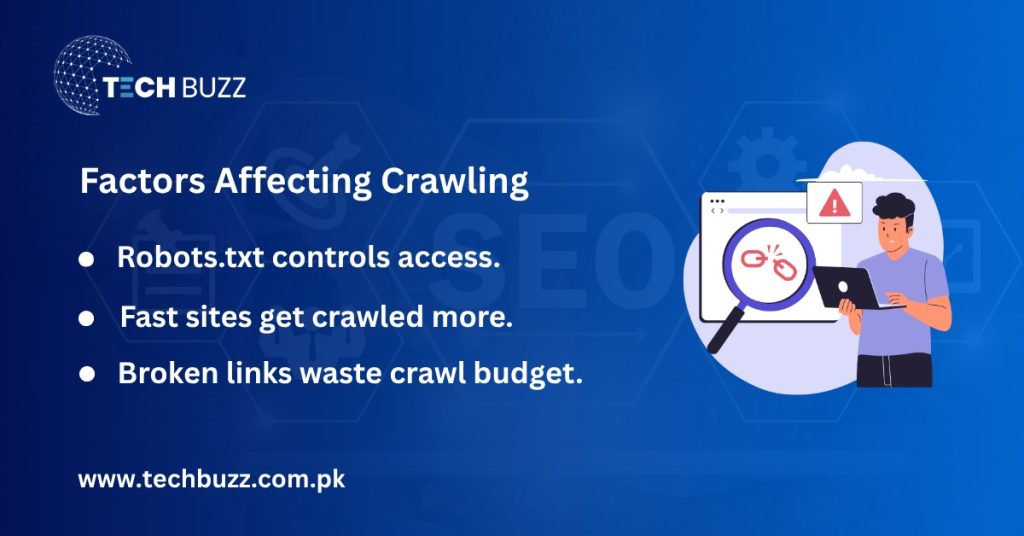
Bots can crawl some websites more easily than others. Your website’s crawlability is influenced by its structure, coding, and upkeep. Here are a few crucial elements:
a) Robots.txt
Search engine bots can determine which parts of your website are crawlable or not by looking at the robots.txt file. It may inadvertently block crucial pages if configured incorrectly.
For instance:
* User-agent: Disallow: /admin/
This indicates that the /admin/ section of your website is inaccessible to all crawlers.
b) Crawl Budget
The number of pages a search engine will crawl on your website in a specified amount of time is known as the crawl budget. It is dependent upon:
- How well-known your website is
- Server performance
- Regularity of updates
- Internal linking quality
Large websites with thousands of pages must optimize their crawl budget to guarantee that search engines find crucial pages first. Partnering with a professional digital marketing agency can help analyze your site’s performance, prioritize key pages, and ensure that search engines efficiently crawl the most valuable sections of your website.
c) Site Speed
Bots might not be able to efficiently crawl all of your pages if your website loads slowly. Deeper crawling is encouraged by websites that load quickly.
d) Incomplete Connections
Links that are dead or broken direct crawlers to error pages, wasting crawl budget and decreasing crawl efficiency.
e) Content Duplicity
Multiple URLs containing the same content could confuse crawlers about which version to index. This may make you less visible in search results.
f) Dynamic content and JavaScript
Although not all bots can render JavaScript, Googlebot can. JavaScript may prevent important content from being correctly crawled or indexed.
6. How to Improve Crawling on Your Website
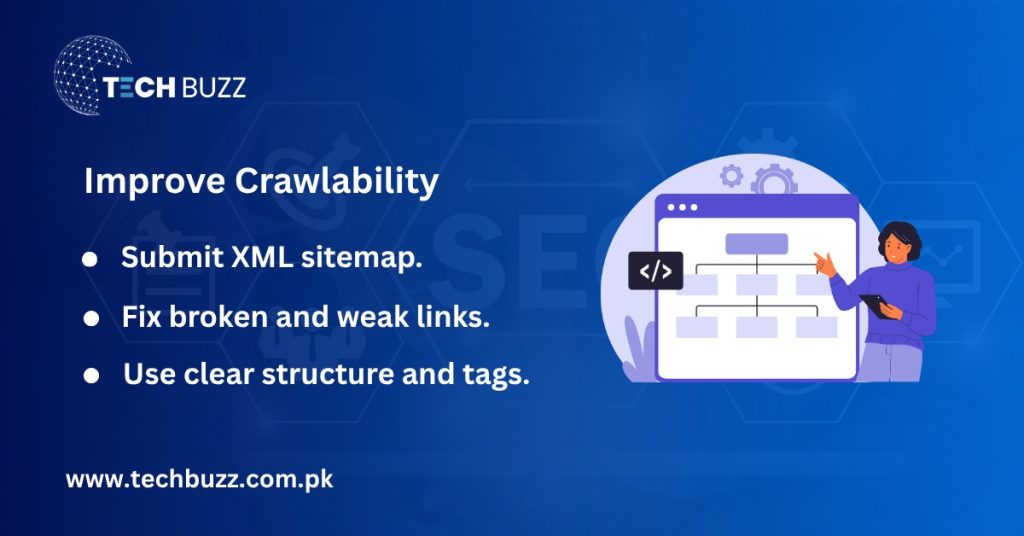
Search engines can efficiently access, comprehend, and rank your content if you optimize it for crawlability. Here’s how to do it:
1. Make a sitemap in XML
A sitemap acts as a road map for search engines. It tells bots which pages are important and how frequently updates occur. One can be made using WordPress plugins like Yoast SEO or online sitemap generators.
2. Make Your Robots.txt File More Effective
Carefully use robots.txt to direct crawlers. Keep your primary pages accessible while blocking any extraneous pages (such as admin sections or duplicate content).
3. Strengthen Internal Connections
Connect your homepage and other popular pages to your key pages. Make use of informative anchor text that makes it obvious to search engines what the linked page is about.
4. Repair Damaged Links
Use tools like Google Search Console or Screaming Frog to regularly check for and fix broken links.
5. Make Use of Canonical Tags
When there are several versions of a page, canonical tags inform search engines which version is the preferred one. This helps prevent problems with duplicate content.
6. Make Your Website Faster
Use a reputable hosting company, compress images, and allow browser caching. Both crawl efficiency and user experience are enhanced by a quick website, making it easier for web spiders to navigate and index your pages effectively.
7. Maintain Clear and Consistent URLs
Make use of brief, keyword-rich URLs that accurately convey the content of the page. Steer clear of lengthy sequences of symbols or numbers.
8. Update Your Content Frequently
Websites that remain active are favored by search engines. Keeping your content updated lets crawlers know that your website is current and relevant.
7. What Takes Place When a Website Isn’t Indexed or Crawled?
Search engines won’t show your content in results if they don’t crawl or index your website, no matter how excellent the content is. Typical explanations include:
- Robots.txt is blocking
- Unintentionally, the noindex tag was used.
- Server malfunctions or outages
- Inadequate internal connections
- Duplicate or thin content
Google Search Console’s “Coverage” report allows you to see which pages are indexed. If any pages are missing, examine the structure of your website, correct any mistakes, and submit an indexing request. This helps the Google crawler efficiently re-scan your site, identify updates, and ensure that all important pages are properly indexed in search results.
8. Resources to Track and Enhance Crawling
You can use a number of both free and paid tools to examine and improve how search engines index your website. These tools help you understand how a web crawler in SEO interacts with your site, identifies issues, and ensures all important pages are accessible for indexing:
- Use Google Search Console to submit sitemaps and view crawl statistics and indexing status.
- Bing Webmaster Tools: Search Console on the Bing platform.
- Screaming Frog SEO Spider: Analyzes on-page SEO elements and crawl issues.
- Ahrefs Site Audit: Monitors crawlability, broken links, and performance issues.
- Sitebulb: Provides a visual depiction of the site’s architecture and crawl paths.
Regular use of these tools guarantees that your website remains search engine optimized and helps improve the efficiency of the web crawler in SEO as it navigates through your content.
9. Complex Crawling Ideas
a) Crawl Depth
Crawl depth refers to the number of clicks it takes to reach a page from the homepage. When users need to click more than three or four times to access a page, search engines are less likely to crawl it regularly. You can improve crawl depth by placing key pages closer to the homepage. Additionally, using a robot meta tag can help control how search engines crawl and index specific pages, ensuring that only important content is prioritized.
b) The frequency of crawls
This is the frequency with which a search engine returns to your website. Websites with high authority and regular updates receive more crawls than those that are static or small.
c) Raw HTML Crawling vs. Rendered
JavaScript frameworks are used by some contemporary websites. Crawlers may:
- Read HTML in its raw form (traditional crawling)
- To load dynamic content, render JavaScript.
If your website uses a lot of JavaScript, render content on the server side or ensure the HTML displays all necessary content. Partnering with a professional custom web development service can help you optimize your site’s structure, ensuring that both users and search engine crawlers can easily access and understand your content.
10. Artificial Intelligence’s (AI) Function in Indexing and Crawling
Modern search engines now use AI and machine learning to make crawling and indexing more effective. Google’s AI-based systems, such as RankBrain and BERT, help the crawler understand not just the words but also the context and intent behind the content. Understanding indexing vs crawling is crucial here; while crawling involves discovering web pages, indexing focuses on storing and organizing that information so it can appear in search results more accurately.
AI, for example, assists:
- Find duplicate or poor-quality pages more quickly
- Make new and pertinent content your top priority. Recognize multimedia components (pictures, videos, etc.)
- Search engines are getting better at spotting worthwhile content and filtering out thin or spam pages as AI advances.
11. Frequently Held Myths Regarding Website Crawling
Let’s dispel some myths:
Myth 1: “Google will find my site automatically if it is new.”
Not all the time. A sitemap, manual submission, or backlinks are required.
Myth 2: “Higher rankings are associated with more pages.”
If those pages aren’t relevant or crawlable, quantity is irrelevant.
Myth 3: “Everything is visible to crawlers.”
False. Crawlers cannot see certain scripts, private pages, or blocked content.
Myth 4: “A page is permanently indexed once it is.”
If a page is blocked, removed, or judged to be of poor quality, it may be deindexed.
12. Top Techniques for Continuous Crawl Optimization
To guarantee that your website stays crawlable and SEO-friendly over time:
- Use crawling tools to audit your website once a month.
- As new pages are added, make sure your sitemap is updated.
- Eliminate any duplicate or out-of-date pages.
- Page speed and mobile optimization should be prioritized.
- Keep an eye on Google Search Console’s crawl errors.
- Create backlinks of superior quality to draw in more crawlers.
Search engines always rank a site higher in search results when you regularly update, organize, and maintain it well. Consistent link building efforts further strengthen your site’s authority, helping search engines recognize your pages as trustworthy and relevant within your niche.
TechBuzz Digital Learning Series: The Power of Website Crawling in SEO
According to TechBuzz, knowing how search engines perceive your website is the first step towards having a strong online presence. We examine the importance of website crawling in SEO in this installment of our Digital Learning Series. This procedure determines how effectively search engines locate, index, and rank your website. By describing how crawlers like Googlebot navigate your pages and optimizing the site’s structure, speed, and links, this guide helps you get the most out of your website’s visibility. Whether you are a developer, marketer, or business owner, the first step to building a high-performing, search-friendly online presence is understanding website crawling.
Conclusion
In conclusion, anyone who wants to improve their website’s SEO performance needs to be well-versed in website crawling. Crawling in SEO plays a foundational role in ensuring your content is discoverable by search engines. Easy crawling, indexing, and interpretation by search engines increases the likelihood that your content will rank higher in search results. By focusing on internal linking, clean URLs, site speed, and tools like sitemaps and robots.txt, you can make crawlers work more efficiently.
Crawlability optimization is evolving from a technical problem to a strategic one as a result of AI and machine learning altering search algorithms. A well-structured, frequently updated website with solid link building and sound technical foundations will always rank higher in search results and garner more trust from users. Contact TechBuzz right now if you want to improve your website’s SEO performance or require professional advice on technical optimization. Our team of experts is here to help you increase your online presence and accomplish long-term success in the digital world.
What does SEO website crawling entail?
In order to index your website, search engine bots must crawl it and comprehend its content. To ascertain the relevance and ranking of your website on search engine results pages, they examine its structure, links, and keywords.
How can I increase the crawlability of my website?
Make sure your website has no broken links, loads quickly, and has clear internal links. Additionally, to aid search engines in efficiently crawling your website, create and submit an XML sitemap.
What is the significance of crawling for SEO?
Your pages will be less visible in search results if search engines are unable to locate or index them due to crawling.