
Summary: SEO KPIs continue to evolve, and businesses can no longer rely solely on keyword rankings to measure success. As AI-powered search experiences become more prominent, companies must focus on metrics that reflect real visibility, user engagement, and business outcomes. With the rise of Google AI Search and LLMs, SEO strategies need to adapt to remain competitive in both traditional and AI-generated search results. In this guide, we will discuss the SEO KPIs that matter most in 2026 and how businesses can use them to improve rankings, attract qualified traffic, and drive sustainable growth.
______________________________________________________________________
Key SEO KPIs That Boost Search Rankings in 2026
SEO Services | AI Search Results | AI SEO
SEO KPI’s will continue to transform year after year. Businesses can no longer solely focus on keyword tracking. Faster search engines in 2026 will have a better understanding of users. With the rise of Google AI Search, businesses must adapt SEO strategies to ensure their websites remain visible and relevant within AI-powered search experiences.
Most successful businesses will understand that 2026’s LLM SEO strategies rely on more meaningful Key Performance Indicators (KPIs). Metrics will be focused on search, user experience, and business success. This will help organizations understand which metrics they can improve. This will also help determine how to adapt and where to allocate resources for more sustainable profitability.
This guide will examine the KPIs organizations will need to measure and track in order to impact SEO ranking. This guide will also outline how to adapt business strategies to measure success.
What are SEO KPIs?
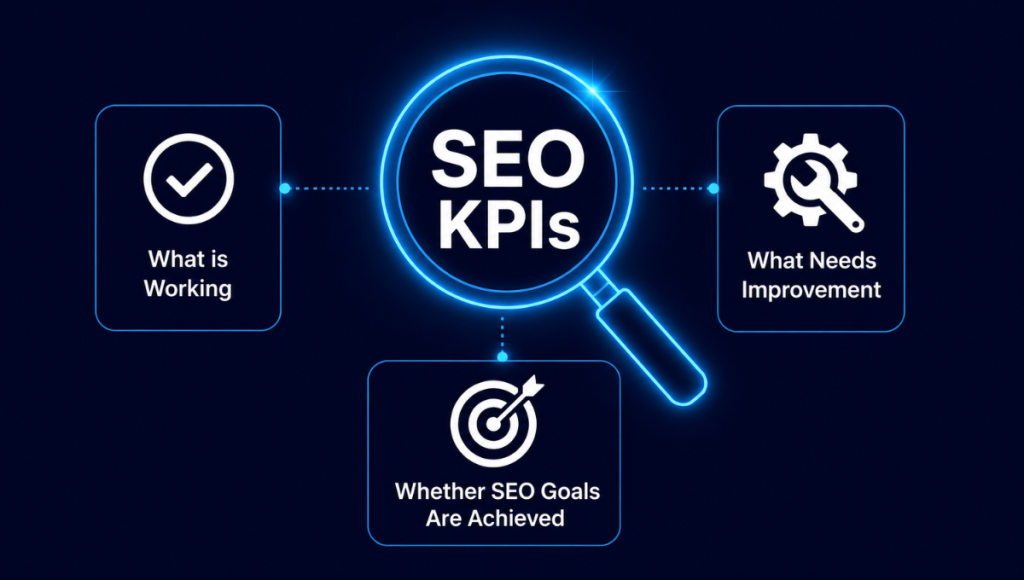
SEO KPIs, or Search Engine Optimization Key Performance Indicators, assess the performance and success of an SEO strategy using specific measurable metrics. With SEO KPIs, businesses can see whether their strategy is strengthening their ranking on search engines, gaining organic traffic, and boosting conversion metrics
Search engine KPIs are different from general SEO metrics in the sense that they are more specific and linked to a particular business goal. SEO KPIs assist marketers in defining measurable goals and tracking performance to support SEO efforts by identifying improvement areas and measuring ROI related to the activities.
Why SEO KPIs Matter More Than Ever for AI Search Visibility?
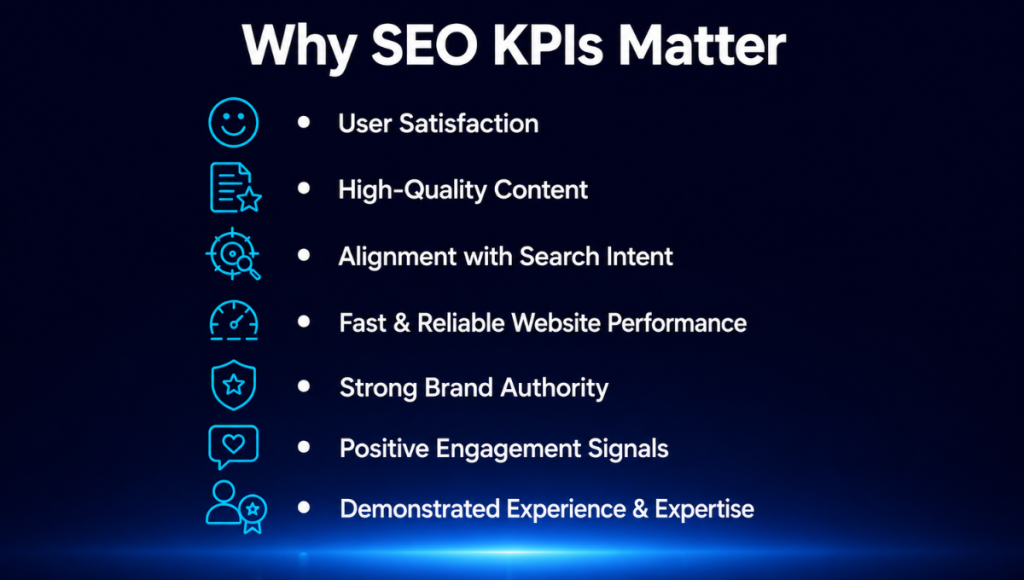
Modern search algorithms assess hundreds of elements when determining rankings. Search engines are focusing more on:
- User satisfaction
- Content quality
- Fulfillment of search intent
- Website performance
- Brand authority
- Engagement signals
- Experience and expertise
Because of all these, businesses must create relevant KPIs. Simple metrics that only track a single measurement of SEO performance are no longer acceptable.
Some Leading SEO Performance Metrics in 2026
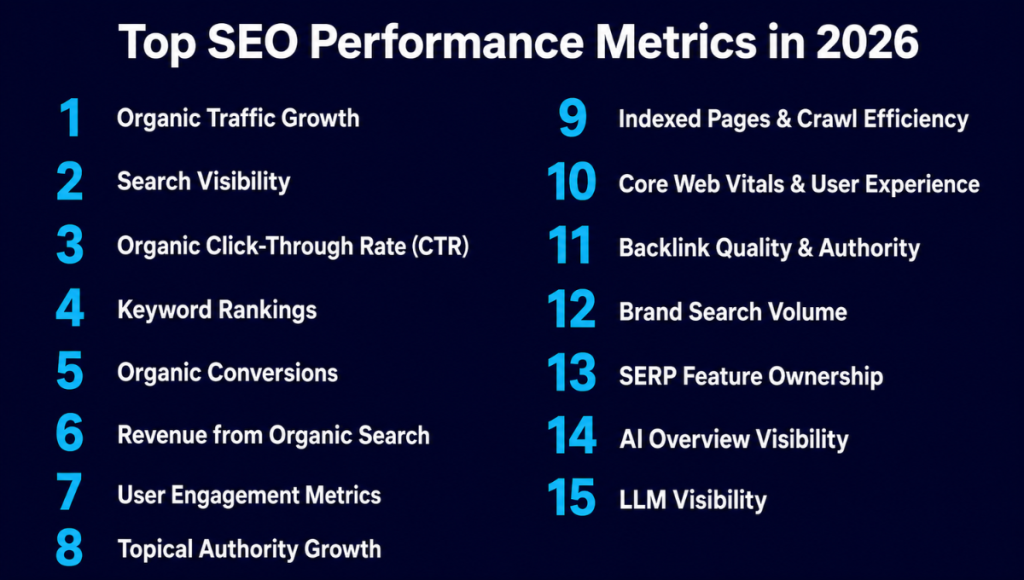
1. Organic Traffic Growth
In 2026, organic traffic will still be a top SEO KPI. Search engines have countless results. Organic conversions count those visitors found through unpaid results. Steady organic traffic shows ranking relevancy. Optimizing search ranking leads to higher visibility of your website. High visibility of your website leads to growth in users who visit your site.
Organic traffic growth indicates:
- Higher rankings of keywords
- Better visibility through searches
- More exposure of your brand
- Content is more successful
2. Search Visibility
Search visibility is a better metric than standard ranking reports. It includes numerous keywords, measuring how often your website is shown to users, as opposed to ranking for a limited number. Search visibility shows how successful your SEO strategies were as a whole.
Search visibility benefits:
- Better depiction of overall performance
- Less engagement with singular keywords
- Greater understanding of your competition in the market
3. Organic Click-Through Rate (CTR)
This metric shows, given the total number of search result impressions, how many users clicked on your result. An organic search ranking does not guarantee a level of traffic to your site.
For example, a page ranked third, but with a good title, can generate more clicks than a page ranked second, but with a poor title.
CTR affects:
- Traffic
- SEO results
- User engagement
4. Keyword Rankings
Keyword ranking is still useful, but only when used in a particular way. Many companies will monitor keywords that ultimately do not produce sales.
For example:
- Low-intent searches that are simply looking for information
- Overly broad keywords
- Words that are not even related to your services or products
Monitor rankings for:
- Transactional keywords
- Commercial keywords that are investigative
- Keywords that are high-intent and focused on a particular location
- Keywords that are focused on a particular product
It is not just about achieving a higher ranking. It is about achieving a ranking that will impact the growth and revenue of the company.
[New to keyword research? Start with our Keyword Research for Beginners guide and learn the fundamentals.]
5. Organic Conversions
Valuable SEO KPIs include organic conversions. A conversion denotes a completed action.
Conversions include:
- Forms submitted
- Purchases
- Requested demos
- Newsletter subscriptions
- Phone calls
Revenue generation does not solely depend on increased site traffic. For example, if 50% more visitors come to a site, but none make a purchase, the visitors that the site attracts need to be better qualified.
6. Revenue from Organic Search
By 2026, the SEO ROI made from organic search will become the most important SEO KPI. Executives and stakeholders will want to know the following: “How much revenue did the SEO campaign bring to us?”
The revenue matters because it is the easiest metric to show that the SEO work contributed to the overall goals of the business.
Benefits are:
- Easier to justify the budget
- Clearer ROI
- More efficiency in spending the budget
- Revenue Metrics to Monitor
7. User Engagement Metrics
User satisfaction is most important for search engines, which is why one of the important SEO metrics is engagement metrics
Major Engagement KPIs to Track:
- Average engagement time
- Time on page
- Scroll depth
- Pages per session
- Returning visitors
Their engagement shows that content is:
- High quality
- Informative
- User friendly
The more time users spend on content, and the more they interact, the more value search engines see in the content.
8. Topical Authority Growth
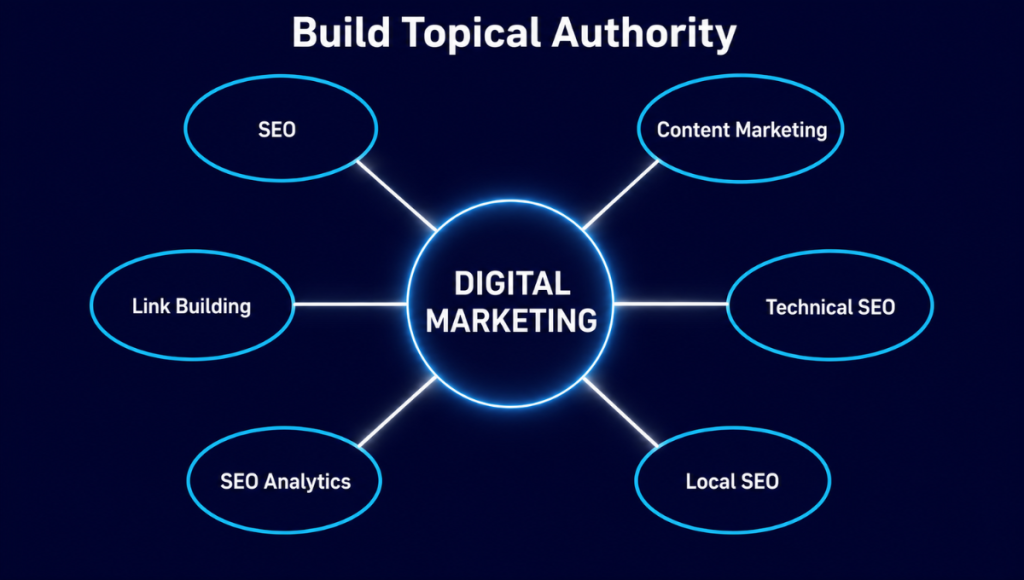
Topical authority has become an important ranking factor. Search engine rankings are based on whether a website has expert knowledge on a given subject. Topical authority looks at the degree to which a website discusses a particular topic. To illustrate, a website that focuses on digital marketing should include:
- SEO
- Content marketing
- Link building
- Technical SEO
- SEO Analytics
- Local SEO
KPI Indicators to Track
- The number of ranked keywords for a specific topic cluster
- The growth of coverage for a particular topic
- Growth of internal linking
- The average performance of content clusters
Establishing topical authority often results in better rankings for all keywords, not just a select few.
9. Indexed Pages and Crawl Efficiency
In 2026, technical SEO will be just as important. Search engines won’t rank pages they can’t crawl and index.
Key Technical KPIs to Track
- Indexed pages
- Crawl Errors
- Crawl Budget Efficiency
- Orphan Pages
- Duplicate Content
Content that is just the best cannot perform if there are barriers to search engines accessing it. Conducting audits regularly enables search visibility.
10. Core Web Vitals and User Experience
The performance of a website impacts user satisfaction and SEO measurement.
Important Metrics TO Track
- Largest Contentful Paint (LCP)
- Interaction to Next Paint (INP)
- Cumulative Layout Shift (CLS)
Websites that are quick to load lead to:
- An improved experience for the user
- Fewer users who disengage
- Significant rises in the number of users
- Better conversion rates
Since search engines focus more on the users, these performance metrics are crucial for SEO.
11. Backlink Quality and Authority
Backlink quality outweighs quantity. While multiple backlinks may be low quality, links from trustworthy, relevant, and authoritative websites are better for SEO. Pay attention to domain authority, relevance, and editorial placement, as well as obtaining links organically. Important metrics that should be evaluated are referring domains, authority growth, link velocity, brand mentions, and link quality scores. These metrics assess the effectiveness, strength, and quality of your backlink profile.
12. Brand Search Volume
Tracking your brand’s search volume in your SEO is critical because search volume indicates the level of brand trust and recognition by searchers. When a larger number of people search for your company or its products and services, it signals search engines that your brand has authority and is relevant and credible. Typically, after some time, a growing presence has a positive impact on your brand’s organic search.
Trends to monitor:
- How often your brand name is searched
- How often are branded keywords clicked
- Branded search volumes
- How often is your brand mentioned?
Strong brand visibility translates to:
- Higher click-through rates
- Greater searches by your target audience
- Stronger domain authority
- Higher organic ranking
With the search algorithms continuing to focus on user search trust and brand recognition, demand for your brand will be a major contributor to your long-term SEO.
13. SERP Feature Ownership
In 2026, AI search results look very different from those in the past, with many competing features like blue links, AI-generated summaries, featured snippets, knowledge panels, video results, image packs, and local packs. Competing for these features even makes your brand more visible and increases your organic traffic, even if you are not moving up the rankings.
Metrics you can measure
- How many featured snippets have you won
- How many rich results do you have
- How often do you show up in the local packs
- How often do your results show up in video results
- How are you ranked in image searches
Why is feature ownership important?
- More visibility on searches
- Higher clickthrough rates
- Increased authority
- More traffic
The results of an advanced SEO strategy have made it so that appearing in these spots is critical to SEO, and search results are going to continue to improve. Capturing these rich features offers a competitive advantage.
14. AI Overview Visibility
Google AI Overviews are changing how users discover information. Businesses should track how often their content appears in AI-generated summaries, as this can increase brand visibility and authority even without a direct click.
What to Measure?
- AI Overview citations
- Keywords triggering AI Overviews
- Brand mentions in AI summaries
- AI-driven traffic
15. LLM Visibility
Users increasingly rely on AI platforms like ChatGPT, Gemini, Claude, and Perplexity for recommendations and answers. LLM visibility measures how often your brand or content appears in these AI-generated responses.
What to Measure?
- Brand mentions across AI platforms
- AI citations and recommendations
- AI referral traffic
- Share of voice in AI-generated answers
Get Qualified Leads with Professional SEO Services by TechBuzz
At TechBuzz, we create personalized SEO solutions for our clients to help fortify their online business presence, find trustworthy, quality, and paying customers, and leverage their digital growth. Our strategies help our clients maximize their visibility on search engines, increase their organic traffic, and identify valuable opportunities to help grow their leads and revenue. We utilize our combination of technical skills, quantitative and qualitative data, and trends to create tailored solutions for our clients based on the client’s goals and target audience.
Further, we offer solutions like seo target keywords and market research, technical search engine and website audits, content marketing strategies and improvements, all forms of search engine local and organic optimization, authority-building campaigns, and, of course, all forms of enhancements and improvements that would increase revenue and conversions for the business. We help assess how your website is currently performing in the search engines, help find opportunities for growth and improvement, and provide improvement recommendations for engagement and visibility. You can have a look at our portfolio and decide for yourself whether you are a new business or a well-established, larger business.
Conclusion
The future of SEO appears to be centered around content and engagement. While keyword rankings will be important, they will not be the only metric for tracking successful SEO. Companies will need to go beyond keyword rankings and focus on metrics and analytics that account for real user engagement, search visibility, and the impacts on the business.
Key metrics of successful SEO include quality of incoming traffic, depth of searches, click-through rate, engagement, Core Web Vitals, and conversion rate, along with topical and backlink authority and organic revenue. All of these metrics combined will account for not only the business’s success, but the growth value the business is bringing as well.
Switching focus from vanity metrics to more useful metrics will also allow companies to maneuver through ongoing changes to search engines and bring in desirable traffic for more fruitful conversions. The continuous changes to searches will be to the benefit of companies that focus on metrics, as opposed to vanity metrics. The focus on user experience and data-backed changes will bring major advantages.
The SEO experts at TechBuzz will help your business achieve growth through organic means and will help build a brand that is not only more visible but is competitive over a long time period. Contact us today for a detailed discussion regarding seo requirements.
FAQs
What are the most significant SEO KPIs for 2026?
There is no definitive KPI for success; however, the quality of organic traffic, the volume of conversions, and search visibility are also highly significant since they correlate most with user engagement and business impact.
What is the role of AI search visibility in SEO?
With the rise of AI-powered search experiences, visibility in the generated AI summary and also in AI-generated answers to searches is gaining more and more significance. AI search engines are more likely to cite and include well-researched, authoritative, and trustworthy content from brands.
What are the recommended review intervals for SEO KPIs?
Most businesses would benefit from a monthly review of SEO KPIs. However, larger sites and eCommerce businesses would benefit from a more frequent weekly review to understand changes in keyword performance and identify opportunities for optimization.