
Summary: Lead generation is the process of identifying and attracting potential customers (leads) interested in a business’s offerings, to convert them into paying clients. Using tactics like content marketing, social media, and outreach, it prioritizes high-quality leads to build a steady sales pipeline, boost revenue, and drive long-term growth.
_____________________________________________________________
Top Lead Generation Strategies | Tips & Tricks to Maximize Conversions
AI Lead Generation | Lead Generation Tools | Lead Generation Strategies
Lead generation is the process of building interest in a product or service and then turning that interest into a sale. Lead gen makes the sales cycle more efficient because it focuses on the strongest and most valuable prospects.
The result is greater success in new customer acquisition and conversion rates. The lead generation process begins with creating awareness and interest. You can start by publishing blog posts that educate your audience and engaging users through social media. You capture potential leads through sign-ups, in which a person voluntarily gives you contact info to stay in touch. This can be through an email newsletter or ”gated” content such as webinars, virtual events, live chats, whitepapers, or ebooks.
What is Lead Generation in Digital Marketing?

In the world of digital marketing, companies clamor for customer attention. We’ve all had to wade through emails bursting with marketing promotions, so it’s understandable that the majority of potential customers have little time for cold calls and marketing material that does not resonate with their needs. That’s why digital marketers focus on identifying leads.
A lead is someone who has shown interest in your company. They may have interacted with your brand in some way, e.g., reacted positively to a social media post. This makes them more likely to engage with subsequent marketing efforts.
Lead generation in digital marketing can occur via multiple channels, including email and social media. Leads may be further defined by the following categories:
Information-qualified lead (IQL): A lead that has offered some information on their specific requirements
Marketing-qualified lead (MQL): A lead that has engaged with your marketing team’s activities
Sales-qualified lead (SQL): A lead that has expressed their desire to become a customer
Meaning of Lead Generation and its Core Importance for Businesses
First, lead generation refers to the process of identifying and attracting potential customers (known as leads) who have expressed interest in a business’s products or services. Furthermore, its core meaning for businesses lies in being a foundational marketing and sales strategy that prioritizes capturing high-quality leads over sheer quantity. Additionally, this process helps build a steady sales pipeline, which in turn drives consistent revenue and supports long-term growth by guiding prospects through the journey to becoming paying clients.
Lead Generation Jobs and Their Key Responsibilities

Lead generation jobs focus on identifying and attracting potential customers for businesses, with the goal of nurturing them into paying clients. Their key responsibilities typically include researching target audiences to find potential leads and using tactics like content marketing, social media outreach, and email campaigns to engage prospects. These roles often involve tracking and analyzing lead data to refine strategies, collaborating with sales teams to pass on qualified leads, and optimizing processes to improve the quality and quantity of leads generated over time.
How B2B Lead Generation Platforms are Changing the Game?
Technology-Driven B2B Lead Generation
Nowadays, B2B lead generation is mainly technology-driven, allowing businesses to scale and refine their marketing efforts efficiently.
CRM Systems: Streamlining Operations & Personalization
Specifically, CRM systems automate routine tasks and unify customer data, which streamlines operations and enables teams to deliver personalized experiences at scale.
Evolution of Buyer-Supplier Networks
Meanwhile, buyer-supplier networks have evolved from the 1990s and 2000s procurement tools. Today, they integrate with CRMs and ERPs to manage the entire sales cycle in one place.
AI: Enhancing Connection & Optimization
In addition, AI has further elevated these platforms. It matches sellers with high-quality leads in real time and optimizes strategies, transforming simple directories into dynamic, data-driven marketplaces.
The Outcome: Trusted, Efficient Networks
Consequently, this creates vibrant networks built on transparency and trust, leading to better procurement processes, stronger B2B relationships, and improved customer experiences.
Lead Generation Specialist Roles and Core Responsibilities
Lead generation specialists identify and attract potential customers to drive business growth. Their core responsibilities include:
– Researching target audiences and sourcing leads via search tools and data platforms.
– Creating or supporting content development and distribution to engage prospects.
– Personalizing interactions with leads, qualifying them against ideal customer profiles.
– Collaborating with sales and marketing teams to ensure a seamless customer journey and boost conversion rates.
Lead Generation Marketing Strategy Key Components and Implementation
A lead generation marketing strategy has key parts to attract and turn potential customers into buyers. First, know your target audience by making clear profiles of who your ideal leads are and what they need.
Then, create a strong value message to show how your product fixes their problems better than others. Also, pick the right channels like social media, email, or ads to reach people easily.
Next, make good, useful content to get prospects interested and make them want to share their contact info.
When putting it into action, start by setting clear goals to measure success. After that, make a plan for your content and run campaigns regularly on your chosen channels.
Also, set up easy ways to collect lead info, like forms or buttons on your pages. Then, build relationships with leads over time to guide them to buy.
Lastly, check how well your lead generation marketing strategy works often, and make changes to get better results.
How to Generate Leads with Simple, Effective Steps?
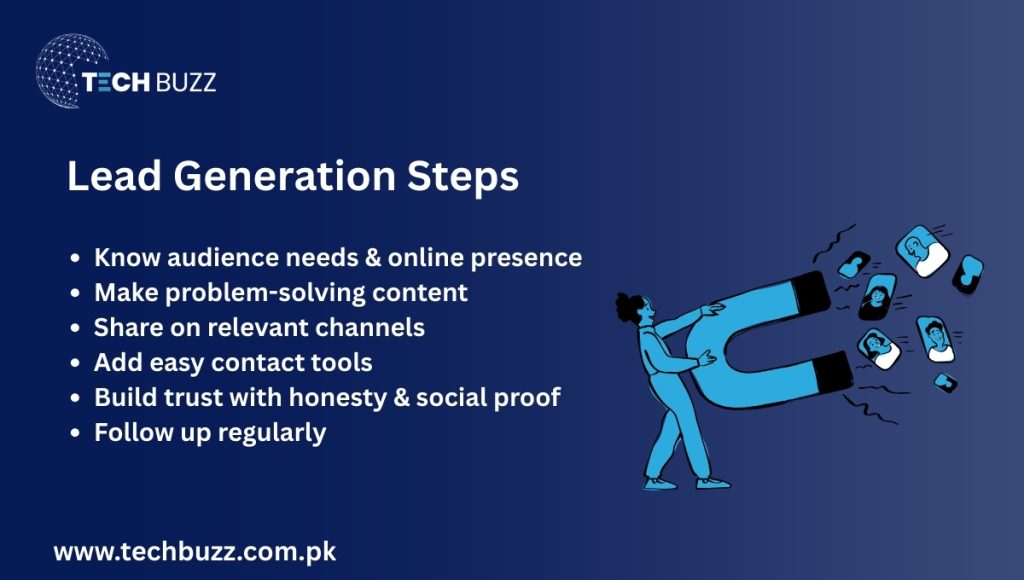
Break down how to generate leads with simple, effective steps
- Know your target audience’s needs and where they spend time online.
- Create useful content that solves their problems.
- Share content on the right channels, like social media or email.
- Add easy contact forms or sign-up buttons on your website.
- Build trust with honest interactions and social proof.
- Follow up regularly to keep leads interested.
If you want to generate leads effectively, TechBuzz can help. They are excellent in IT services, Seo, offering top-quality, budget-friendly, and reliable solutions in Pakistan and worldwide. With a team of highly qualified web designers, developers, and marketers, they provide complete, flexible packages and customized plans for all your needs. TechBuzz stays committed to every project, creating unique strategies to help your business attract and convert more leads successfully.
Sales and Lead Generation, Connection, and Practical Tips
Sales and lead generation are closely connected. Lead generation finds and attracts potential customers interested in your products or services. Sales then works with these leads to turn them into paying clients. Lead generation fills the list of possible buyers for sales, and sales turn those leads into money. Both are needed for business growth.
Practical tips:
– Agree on who your perfect customers are, so leads match what sales needs.
– Share lead information easily between teams to keep follow-up smooth.
– Give leads useful content before sending them to sales.
– Use sales feedback to make lead generation better over time.
Lead Generation Software: Main Uses and Popular Choices
Main Uses
– Find and filter target leads
– Capture contact info via forms, chatbots, and landing pages
– Enrich lead profiles
– Automate outreach and nurture leads
– Score leads for prioritization
– Track performance metrics
– Sync with CRM tools
Popular Choices
– Apollo.io: All-in-one with a large contact database
– HubSpot: Full suite with CRM and marketing tools
– OptinMonster: Website visitor conversion specialist
– LinkedIn Sales Navigator: LinkedIn prospecting tool
– Pipedrive: CRM with lead scoring and pipeline management
– Mailchimp: Email marketing and automation
– Unbounce: AI landing page builder
– Zoho CRM: Affordable lead management solution
Social Media Lead Generation Core Tactics and Effective Practices
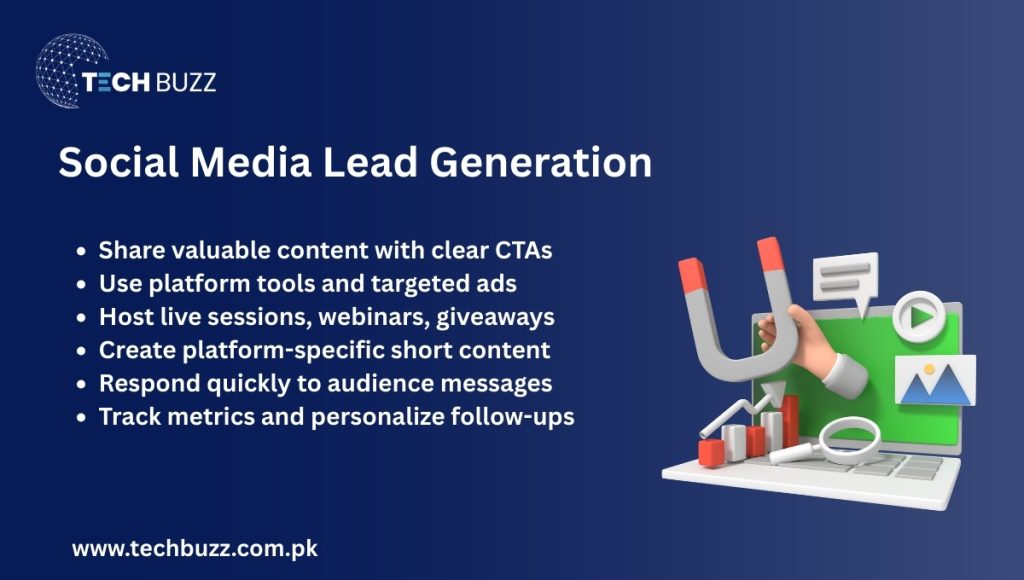
Core Tactics
– Create valuable, audience-focused content (posts, reels, guides) to attract interest.
– Add clear call-to-actions (CTAs) linking to lead forms, landing pages, or sign-ups.
– Use platform-specific lead tools (e.g., Facebook Lead Ads, Instagram Lead Forms).
– Run targeted ads to reach specific demographics and intent-based audiences.
– Host live sessions, webinars, or giveaways to encourage engagement and info sharing.
Effective Practices
– Align content with each platform’s user behavior and format.
– Keep lead capture forms short and simple to reduce drop-offs.
– Respond promptly to comments and messages to build trust.
– Track metrics (conversion rate, cost per lead) to refine strategies.
– Nurture captured leads with personalized follow-ups across channels.
Content Marketing Lead Generation, Unique Pathways, and Smart Moves
First off, explore unique pathways for content marketing lead generation. Create niche-specific interactive quizzes with lead capture for full insights, launch user-generated content campaigns with sign-up links, collaborate on industry podcasts to direct listeners to lead magnets, release sequential micro-content series with a final CTA for guides, and build community hubs where members get exclusive content in exchange for contact info.
Furthermore, adopt smart moves to optimize efforts. Tailor content to each customer journey stage, optimize lead magnets for mobile, repurpose content into multiple formats to reach more audiences, add contextual CTAs within content, and A/B test elements to refine strategies and scale what works.
What are the Practical Lead Generation Apps Available Right Now?
B2B
– Kaspr: Outbound tool for SMBs/individuals with fresh European data; LinkedIn-compatible extension, workflow integration, free version available.
– Cognism: For large enterprises, compliant European market data; AI intelligence, intent data, verified contacts, 25 free test leads.
– Apollo.io: All-in-one with lead gen, CRM, sales engagement, AI scoring, automation; suits all businesses.
B2C
– OptinMonster: Converts visitors via pop-ups/forms, exit-intent tech.
– Leadfeeder: Tracks leads from ads/websites, identifies visitors; free plan available.
– Mailchimp: Email marketing/automation for lead gen, campaign management; free plan available.
Mobile
– Pipedrive: CRM for pipeline, lead tracking, automation; suits all businesses.
– Popl: Turns real-world interactions into leads, digital profiles, CRM sync; free to use.
– Badger Maps: Field sales route planner, optimizes routes, and visualizes data.
All-in-One
– HubSpot: Free CRM + marketing/sales/service tools, lead capture, AI insights; ideal for startups, free version available.
– Zoho One: 45+ apps with CRM, automation, lead management, web/social integration; customizable for all businesses.
What is a Lead Generation Funnel and How Does it Work?

A lead generation funnel is a structured framework that guides potential customers from their first brand interaction to becoming qualified leads and eventually paying customers.
It works in key stages:
- Awareness: People learn about your brand via content, ads, or word-of-mouth.
- Interest: They engage with your content and show curiosity about your offerings.
- Consideration: They evaluate your products/services against others, supported by detailed content like case studies.
- Intent: They take clear action (e.g., downloading a lead magnet, signing up for a trial) to become a lead.
- Evaluation: Your team assesses if the lead is a good fit.
- Conversion: Qualified leads become paying customers.
Post-conversion, nurturing existing customers drives repeat business and referrals, creating a continuous growth cycle.
Master Lead Gen: Build Your Brand, Partner with TechBuzz, Use Tech Insights
Lead generation success hinges on strong branding and strategic tech-focused partnerships. Build your brand by engaging with tech trends and sharing insights that link your offerings to relevant topics—this positions you as knowledgeable and builds trust with potential leads.
Partner with tech-focused brands, influencers, or trend-setting platforms to tap into their established, tech-savvy audiences. Collaborate on co-created content or campaigns to reach qualified leads who are already interested in your space, turning these connections into valuable, sustainable lead generation opportunities.
Discover more about us and find the right social media management methods for your 2026 objectives with TechBuzz.
Conclusion
Mastering lead generation is a blend of smart tips, practical tricks, and long-term strategies that form a complete, adaptable guide. Start by building a strong brand presence and leveraging tech trends and partnerships to expand your reach. Use targeted content, data insights, and collaborative campaigns to attract and nurture qualified leads, while refining your approach based on performance. Remember, successful lead generation isn’t just about quick wins—it’s about creating sustainable, trust-driven processes that consistently connect you with the right audience, driving growth and long-term business success. Take your online presence to the next level by partnering with Tech Buzz today. Contact us now to learn more.
FAQS
How to build brand presence for lead gen?
Engage with tech trends, share relevant insights, and create content linking your offerings to industry topics. This positions you as knowledgeable, boosts visibility, and builds trust with potential leads.
How do tech partnerships boost lead quality?
Collaborate with tech-focused brands, influencers, or platforms to tap into their established, tech-savvy audiences. Co-created content or campaigns help you reach qualified leads already interested in your space.
What’s data insights’ role in refining lead gen strategies?
Track what resonates with your audience, measure partnership impact, and analyze lead interactions. Use these insights to adjust your approach, align with effective trends, and generate high-quality leads sustainably.