
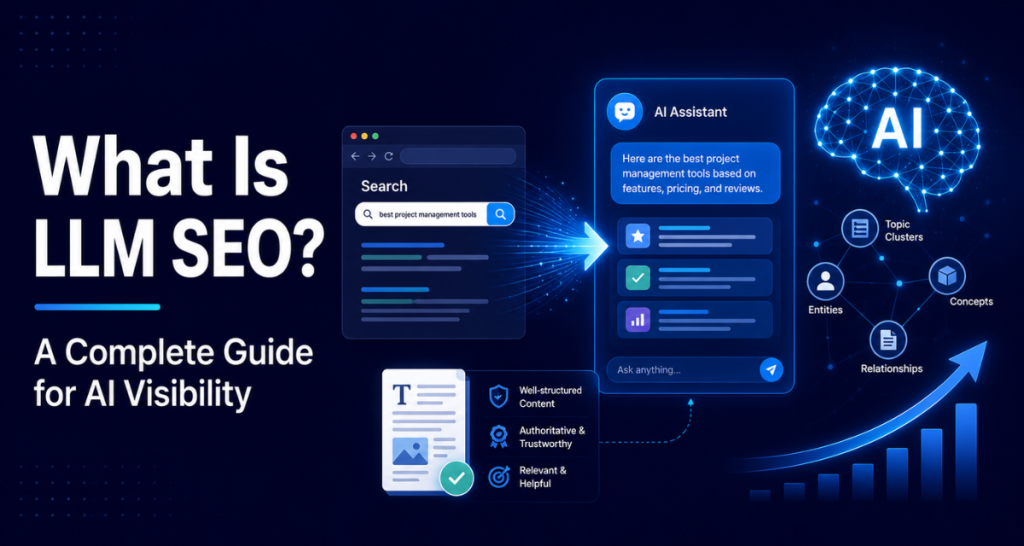
Summary: Search is changing a whole lot quicker than many businesses were expecting. For years, ranking high on Google was what all SEOs were gunning for. But nowadays, users are increasingly asking questions straight to AI platforms like ChatGPT and Gemini instead of trawling through page after page of search results. This sudden shift throws up a whole new problem. Even if your website is ranking top on the search engines, AI assistants just aren’t going to mention your business if they can’t make sense of your content, or can’t trust it, or don’t think to reference it when giving an answer to a user. LLM SEO helps your content become more visible in AI-powered search results.
____________________________________
What Is LLM SEO? How to Optimize for AI-Powered Search
Generative Engine Optimization | AI overview | AI SEO Strategy
LLM SEO is all about making it easy for AI models to find, understand, and confidently reference your content when it comes to giving answers to user queries. It isn’t meant to do away with traditional SEO – in fact, it’s meant to expand your strategy out into the new world of AI-powered search.
The Problem: Traditional SEO Is No Longer Cutting It
Imagine putting in all the hard work to create loads of content, getting backlinks galore, and working your magic to get a top ranking on Google. Your website is finally on the first page.
Traffic is up. But we know what happens next. Users start asking ChatGPT all sorts of questions like: “What is the best CRM for new start-ups?” “Which accounting software is the most user-friendly for independent contractors? “What is the safest GLP-1 medication to take?”
Instead of getting sent off to Google with ten blue links to choose from, AI just gives them the direct answer right there on the spot. But if your business isn’t included in that answer – well, you might as well not even be showing up for users, even if you are top on Google.
This is just one of the biggest shifts in digital marketing that we’ve seen in the last decade. Traditional SEO was all about getting your web pages to rank high. LLM SEO is all about getting your business to be part of the answers that AI is spitting out.
Why AI Visibility Matters
Generative AI adoption continues growing rapidly.
AI helpers are being used by millions of people for:
- Product research
- Health information
- Software recommendations
- Business comparisons
- Technical explanations
- Shopping decisions
Instead of opening multiple browser tabs, users receive summarized answers instantly.
Businesses that become trusted AI references gain:
- Increased brand awareness
- Higher authority
- More qualified visitors
- Better conversion opportunities
- Long-term competitive advantage
Companies ignoring AI optimization risk losing visibility even if their Google rankings remain stable.
What Is LLM SEO?
The process of improving your website and content so AI systems like SEO for ChatGPT, Gemini, Claude, and Perplexity can comprehend, trust, and refer to your material while creating responses is known as LLM SEO (Large Language Model Optimization).
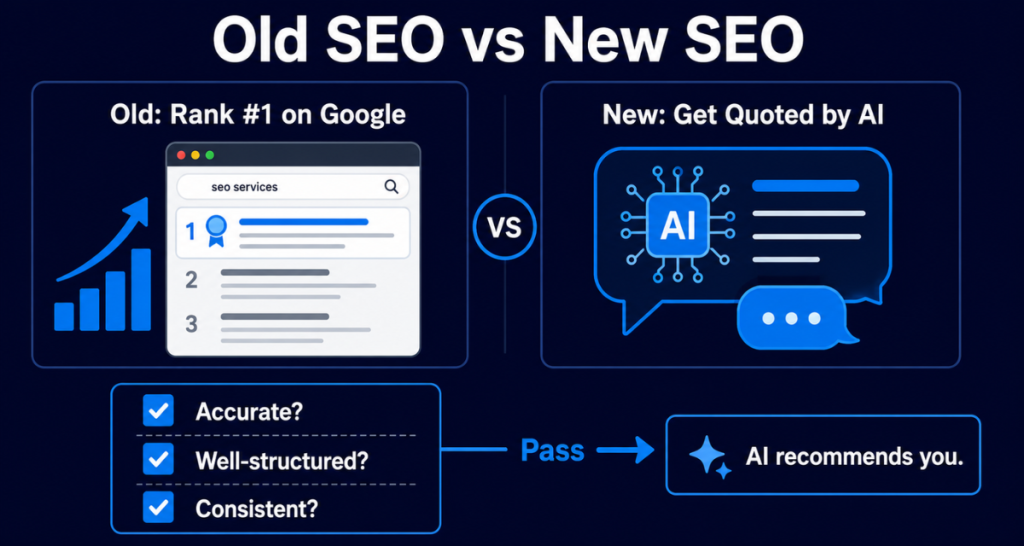
Unlike traditional SEO, LLM SEO focuses less on individual keyword rankings and more on information quality, topical authority, structured content, entity recognition, and factual accuracy.
The goal is straightforward:
Make your information trustworthy enough to be cited and simple enough for AI algorithms to understand.
How LLMs Find Information
Many people assume AI simply searches Google.
That is only partly true.
Modern AI systems gather information through several sources:
- Search engine indexes
- Public web pages
- Structured data
- Knowledge graphs
- High-authority websites
- Government resources
- Research publications
- Trusted documentation
- Frequently cited content
They evaluate information based on credibility, consistency, and context rather than keyword density.
That is why comprehensive content often performs better than pages written solely around exact-match keywords.
Why AI Prefers Certain Content
AI models prioritize content that demonstrates expertise.
Common characteristics include:
Clear Structure
Headings, lists, tables, and logical organization help AI understand relationships between ideas.
Direct Answers
Instead of lengthy introductions, answer questions immediately.
For example:
“What is LLM SEO?”
Provide a concise definition before expanding.
Consistent Facts
Contradictory information reduces confidence.
Statistics should match reliable sources.
Dates should be current.
Definitions should remain consistent throughout the article.
Topical Authority
One excellent article helps.
Ten interconnected articles covering every aspect of the subject help much more.
The Core Elements of LLM SEO
1. Build Topic Clusters
Instead of publishing isolated blog posts, organize content around one central
Main Guide:
What Is LLM SEO?
Supporting Articles:
- Entity SEO
- AI Search Optimization
- Structured Data
- Knowledge Graphs
- GEO vs SEO
- AI Content Optimization
- Schema Markup Guide
This structure demonstrates expertise.
2. Optimize for Entities
Entities are people, organizations, products, locations, and concepts that AI recognizes independently of keywords.
For instance:
Rather than using:
“Greatest AI Search”.
Mention:
- ChatGPT
- Google Gemini
- Claude
- Perplexity
- OpenAI
- Anthropic
These entities provide context.
3. Add Structured Data
Schema markup helps machines understand:
- Authors
- FAQs
- Products
- Reviews
- Organizations
- Articles
Schema enhances machine readability but does not ensure AI citations.
4. Demonstrate Experience
Generic AI-written articles are becoming common.
What stands out?
Original insights.
Examples include:
- Personal testing
- Client results
- Industry observations
- Process documentation
- Expert opinions
Experience creates differentiation.
5. Keep Information Updated
AI values fresh information.
Review important content regularly.
Update:
- Statistics
- Product features
- Industry changes
- Regulations
- Examples
The Role of E-E-A-T in LLM SEO

Google introduced E-E-A-T:
- Experience
- Expertise
- Authoritativeness
- Trustworthiness
Interestingly, these same signals help AI systems evaluate credibility.
Include:
- Author profiles
- Company information
- References
- Original research
- Accurate citations
Both search engines and AI assistants are starting to use trust as a ranking element.
Core Principles of Authority Building in LLM SEO
One of the most powerful signals for AI visibility is now authority. Unlike traditional SEO, where keyword optimization often played a dominant role, large language models prioritize content from sources that consistently demonstrate expertise, accuracy, and trustworthiness. Building authority is no longer optional—it is essential for increasing the likelihood that AI systems will reference your content.
Publish Original Research
Original research gives your content a competitive advantage because it provides information that cannot be found elsewhere. Surveys, industry reports, customer insights, proprietary data, and case studies offer unique value that AI models are more likely to recognize and reference.
Build Topical Authority
Instead of publishing isolated blog posts, create comprehensive topic clusters that cover a subject from multiple angles. A pillar page supported by detailed articles helps establish your website as a trusted resource while making it easier for AI systems to understand your expertise.
Earn Trusted Mentions
Mentions from respected industry websites, reputable publications, universities, government organizations, and authoritative blogs strengthen your credibility. The reputation of your company is strengthened by these third-party references, which also enhance trust signals for AI systems and search engines.
Keep Content Updated
AI systems favor content that reflects current information. Regularly update statistics, examples, screenshots, product information, and references to ensure your content remains accurate, relevant, and useful.
Demonstrate Real Expertise
Showcase genuine expertise by including author biographies, first-hand experience, real client case studies, expert opinions, and transparent sourcing. Content backed by real-world knowledge is more trustworthy than generic articles written solely for search rankings.
Building authority is a long-term investment rather than a one-time optimization. AI models are more likely to trust and reference brands that consistently publish accurate, well-supported, and experience-driven content than websites that simply optimize for keywords.
Common Mistakes Businesses Make
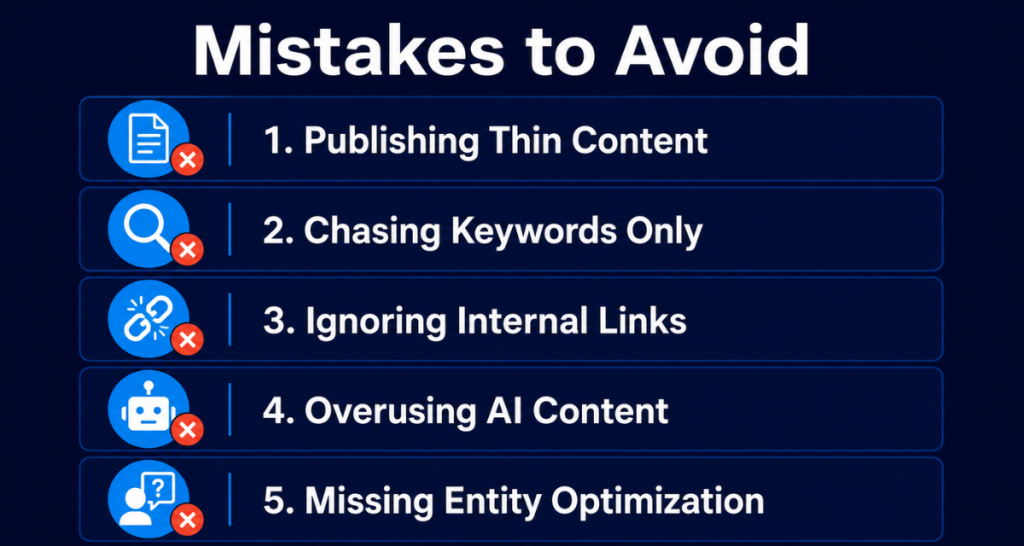
Publishing Thin Content
Articles with little substance rarely become trusted references.
Chasing Keywords Only
Modern optimization requires answering complete user questions instead of repeating phrases.
Ignoring Internal Links
Topic clusters strengthen semantic understanding.
Overusing AI Content
AI-generated drafts should always be edited by experts.
Original insights matter.
Missing Entity Optimization
Mention important people, products, technologies, and organizations naturally.
Measuring LLM SEO Success
Unlike traditional SEO, rankings are not the only metric.
Track:
- References to brands in AI answers
- AI platforms’ referral traffic
- Organic traffic growth
- Topical authority
- Engagement metrics
- Branded searches
- Conversion rate
New analytics tools continue emerging specifically for AI visibility.
Why AI Monitoring Matters

Publishing AI-friendly content is only part of an effective LLM SEO strategy. To improve AI visibility over time, you also need to monitor how large language models reference your brand and content. Since AI-generated responses evolve as models are updated and new information becomes available, regular monitoring helps ensure your business remains visible and accurately represented.
AI Search Results are increasingly powered by Large Language Models (LLMs), making LLM SEO essential for improving content visibility across AI-driven search platforms. AI monitoring offers insightful information on how your brand appears on ChatGPT, Gemini, Claude, and Perplexity, among other platforms. It enables you to:
- Monitor mentions of your brand on various AI platforms.
- Identify which pages or resources are referenced most frequently.
- Detect inaccurate or outdated AI-generated information about your business.
- Compare your AI visibility with competitors.
- Measure the impact of new content, schema implementation, and optimization efforts.
Several AI tools can help monitor AI visibility, including Peec AI, Profound, Scrunch AI, Semrush AI Toolkit, and Ahrefs Brand Radar (where available). In addition to using these tools, manually testing important prompts across multiple AI platforms can help you understand how your brand is being represented and identify opportunities for improvement.
As AI-powered search continues to evolve, monitoring should become a regular part of your SEO workflow. Businesses that consistently track their AI visibility can identify content gaps, respond to changes more quickly, and strengthen their presence before competitors gain an advantage.
Real Case Study: HubSpot’s Topic Cluster Strategy
One of the most widely referenced examples of topical authority comes from HubSpot.
Beginning around 2017, HubSpot shifted from creating isolated keyword-focused articles to building comprehensive topic clusters centered on pillar pages.
Rather than publishing disconnected posts, the company created in-depth guides on subjects like inbound marketing, CRM, email marketing, and sales automation, then linked dozens of related articles back to each pillar page.
According to HubSpot’s published marketing insights and conference presentations, this strategy contributed to significant long-term organic growth by improving topical relevance and helping search engines better understand content relationships.
Additionally, the same structure fits in nicely with the way that contemporary AI systems handle data. Articles that are interconnected, consistently updated, and supported by related content are easier for language models to interpret as authoritative sources than standalone pages covering a topic only once.
While HubSpot has not publicly attributed specific traffic gains to “LLM SEO,” its content architecture reflects many of the principles now recommended for AI visibility, including topical authority, structured information, internal linking, and comprehensive coverage.
The lesson is obvious: creating a network of connected, helpful material adds long-term value to both AI-powered search experiences and conventional search engines.

Practical Steps to Improve AI Visibility
Start with these actions:
- Publish complete guides instead of short articles.
- Organize content into topic clusters.
- Use descriptive headings.
- Answer questions directly.
- Include FAQs.
- Add schema markup.
- Update older articles.
- Build author credibility.
- Strengthen internal linking.
- Earn mentions from trusted websites.
- Reference reliable data.
- Maintain factual accuracy.
More important than providing a lot of stuff is consistency.
The Future of SEO Is Hybrid
SEO is not disappearing.
It is evolving.
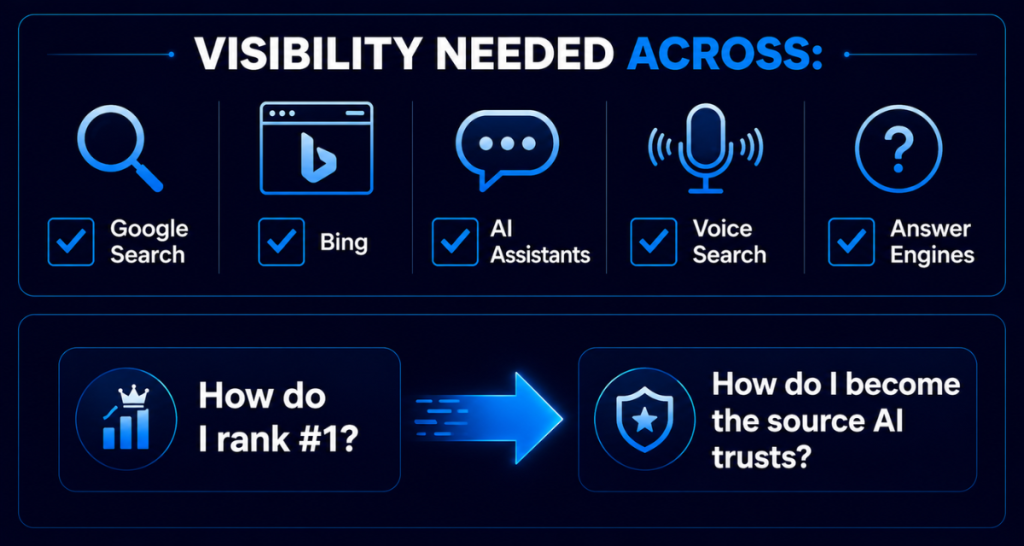
Businesses now need visibility across:
- Google Search
- Bing
- AI assistants
- Voice search
- Answer engines
Early adopters will eventually develop greater digital authority.
Rather than inquiring,
“How do I rank #1?”
“How do I become the source AI trusts?”
should be your first question.
That mindset will shape the next generation of search optimization.
Boost Your AI Visibility with TechBuzz
Navigating the rapidly evolving landscape of LLM SEO, GEO, and AI-powered search can be overwhelming. That’s why TechBuzz Digital Marketing Agency offers comprehensive AI visibility audits and managed AI SEO strategies to ensure your brand not only survives but thrives in this new era. Our team of experts handles everything from technical schema implementation and llms.txt generation to content strategy and brand entity optimization. We help you get cited by ChatGPT, Gemini, and Google AI Overviews, driving high-intent traffic and boosting your brand authority. Join together with TechBuzz to increase your AI visibility and take the lead in your sector’s discourse.
Final Thoughts
LLM SEO represents the next stage of search optimization. As AI assistants become a common starting point for research and purchasing decisions, businesses need content that goes beyond keyword targeting. They need information that is clear, accurate, well-structured, and genuinely helpful.
The most effective approach blends AI visibility techniques with conventional SEO. Continue optimizing for search engines, but also focus on topical authority, entities, structured data, trustworthy information, and real expertise. Together, these elements improve your chances of being discovered not only in search results but also in AI-generated answers.
By investing in LLM SEO now, brands are setting themselves up for future search trends. The objective is to become a reliable source that AI systems can recommend, not only to get a click.
Want to boost your visibility in AI-powered search? Contact our team to get started.
Frequently Asked Questions
What distinguishes LLM SEO from conventional SEO?
Instead of taking the place of regular SEO, LLM SEO enhances it. While traditional SEO aims to improve your website's visibility in search engine results, LLM SEO focuses on making your content easier for AI platforms like ChatGPT, Gemini, Claude, and Perplexity to understand and reference. Using both approaches together creates a stronger long-term search strategy.
How can I make my website more visible in AI search results?
Focus on creating helpful content that answers real user questions, organize related topics into clusters, optimize for entities, and keep your information accurate and updated. Your chances of being cited by AI platforms can also be increased by including fresh ideas, case studies, and reliable references.
Does using AI-generated content improve LLM SEO?
Although AI can expedite the generation of content, it shouldn't be your last resort. Review every draft, add your own insights, use reliable sources, and make sure the content is accurate, useful, and written for real readers.